Five Subsystems, Seven States: What the Collins–Bell FLRAA Package Reveals About the MV-75 Supply Chain
The MV-75 Cheyenne II is a Bell Textron tiltrotor. The 13 April 2026 teaming announcement with Collins Aerospace — a business of RTX Corporation, distinct from the separate Raytheon defence segment — adds texture to that framing: a significant slice of the Army’s next-generation assault aircraft is now a Collins Aerospace commercial-derivative supply chain spread across seven US states, and the architecture has been chosen deliberately to absorb the schedule compression the Army is now imposing on the programme.
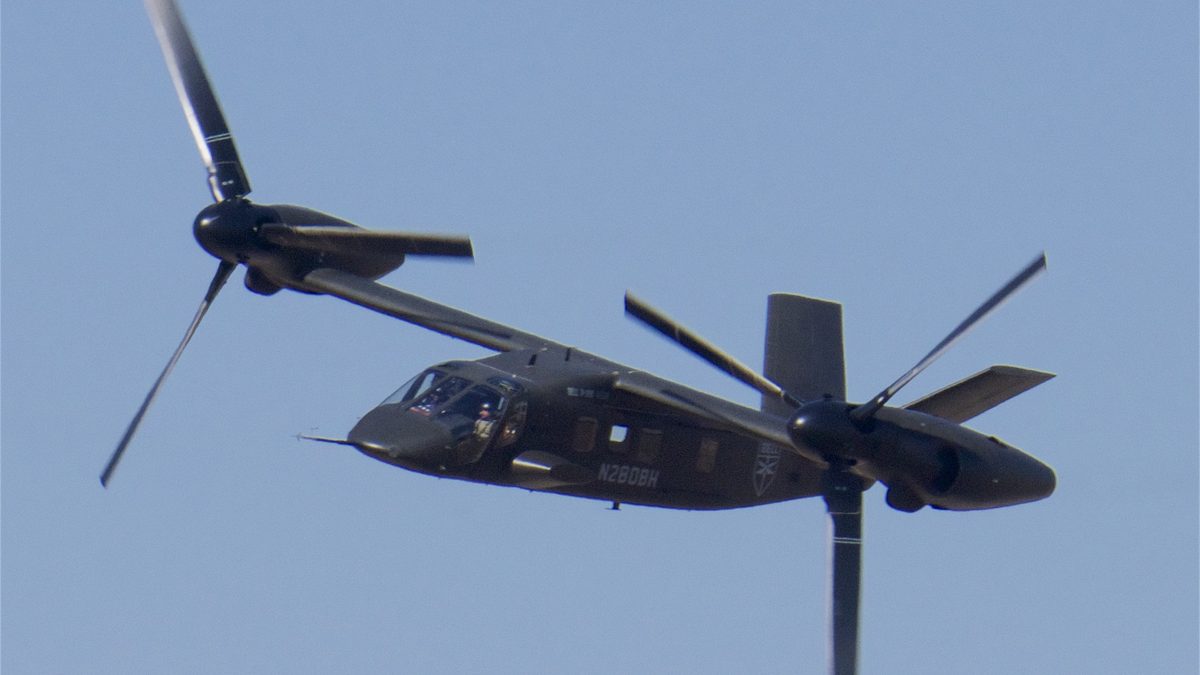
On 13 April 2026, Bell Textron selected Collins Aerospace to supply five critical subsystems for the US Army’s Future Long Range Assault Aircraft (FLRAA), now designated MV-75 Cheyenne II. The five systems — main power generation, interconnect drive system, SmartProbe® air data, cockpit seating, and ice protection — will be delivered under commercial acquisition authorities rather than traditional defence contracting, and the work is distributed across Collins facilities in Colorado, Illinois, Iowa, Minnesota, New York, Ohio, and West Virginia.
Neither subcontract values nor individual award dates have been publicly released, which is typical for teaming arrangements sitting under a prime contract. The prime itself is well understood: W58RGZ-23-C-0001, awarded to Bell by Army Contracting Command–Redstone Arsenal in December 2022 at an initial ~$1.36 billion, with a development ceiling reported up to ~$7.2 billion and full-life-cycle estimates approaching ~$70 billion across procurement and sustainment of several hundred aircraft.
This analysis examines what the Collins package actually represents: not five discrete awards, but a deliberate industrial architecture designed to de-risk the Army’s most aggressive vertical-lift modernisation in forty years.
The Five-System Package and Why It Matters
The subsystems Collins has been asked to deliver are, individually, unremarkable. None is a headline-grabbing mission system. What is unusual is the breadth of the package and the acquisition vehicle being used to procure it.
| System | Function | Collins product heritage |
|---|---|---|
| Main power generation | Primary electrical power for flight-critical systems | Generators derived from commercial rotorcraft and regional aviation programmes |
| Interconnect drive system | Drive shafts linking the two proprotors and enabling single-engine flight | Certificated rotorcraft driveline hardware |
| SmartProbe® air data system | Multifunction air-data computation (pitot-static, angle-of-attack, sideslip) | In-service on multiple commercial and military fixed-wing and rotary-wing platforms |
| Cockpit seating | Crashworthy pilot and co-pilot seats | Military-qualified seating from Collins’ aerospace interiors portfolio |
| Ice protection | Rotor-blade and airframe ice-protection hardware | Commercially derived electro-thermal and pneumatic systems |
All five have strong commercial heritage. That is the point. Bell has selected what the industry calls “commercial off-the-shelf-derived” (COTS-D) hardware — items already type-certificated for civil use, already in mature production, already backed by a global sustainment network. Procuring them under commercial acquisition authorities cuts the administrative overhead of traditional FAR Part 15 competitive procurement and avoids the cost-plus contracting machinery that typically layers onto defence-unique subsystems.
The logic is that a 50-year platform life-cycle cannot afford subsystems with narrow military-only supply chains. When the MV-75 is still flying in 2075, Collins generators sharing a parts catalogue with commercial rotorcraft will remain economic to sustain. Bespoke military-only hardware, by contrast, ages into obsolescence and creates sustainment liabilities that dwarf the original development cost.
The Seven-State Industrial Footprint
The work is distributed across Collins facilities in seven US states. That distribution is not accidental — it is a deliberate artefact of congressional politics and a hedge against industrial-base concentration risk.
| State | Collins facility role (representative) | Political significance |
|---|---|---|
| Iowa (Cedar Rapids) | Avionics and air data — SmartProbe® heritage site | Senate Armed Services Committee representation |
| Colorado | Electric power systems engineering | Aerospace corridor; NORAD / Space Command state |
| Illinois | Mechanical systems / drive components | House Armed Services Committee representation |
| Minnesota | Interiors and seating | Rotorcraft supplier cluster |
| New York | Actuation and mechanical systems | Appropriations influence; legacy Hamilton Standard sites |
| Ohio | Landing systems / structural subsystems | Swing-state political weight; DoD logistics hub |
| West Virginia | Avionics / systems integration | Senate Appropriations historical influence |
Seven states deliver at least fourteen US Senators with a direct jobs interest in FLRAA, plus a significant bench of Representatives on Armed Services and Appropriations committees. That is not a coincidence. Team FLRAA — Bell as prime, plus GE Aerospace (engines, selected 2025), Collins (these five systems), Lockheed Martin (selected subsystems), and a widening tier-two supply chain — is assembling a political defensive perimeter as dense as its industrial one. Cancellation costs will be measured in jobs in half the country.
MOSA, Acceleration Pressure, and Supply-Chain Risk
The Bell team’s December 2022 selection over the Sikorsky–Boeing SB-1 Defiant was contested. Sikorsky filed a Government Accountability Office protest; the GAO upheld the Army’s decision, citing Bell’s stronger compliance with the Modular Open Systems Approach (MOSA) requirement embedded in the Request for Proposals. MOSA is, by congressional statute under 10 USC §4401, now a non-discretionary requirement for major defence acquisition programmes — interfaces must be open, components must be replaceable by competing suppliers, and the prime cannot hold the Government hostage to proprietary technology over the platform life-cycle.
The Collins package reads as a MOSA selection: each of the five systems has a defined interface, a commercial-standard specification, and — in principle — a replacement supplier in the event of Collins withdrawal, failure, or competitive displacement. Whether MOSA will deliver on that promise remains to be tested, but the architecture now being laid down is consistent with the statutory mandate and with the Army’s declared intent to use FLRAA as a pathfinder for open-architecture rotorcraft.
Acceleration pressure is now the defining programme risk
Initial fielding to the 101st Airborne Division was originally scheduled for FY2030–2031. Over the past twelve months, senior Army leadership — including the Secretary of the Army and the Chief of Staff — have publicly pressed Bell for a compressed schedule targeting 2028 or earlier, via what officials describe as “over-investment” in tooling, test assets, and supplier capacity. The rationale is the Pacific theatre: the range and speed advantages of a tiltrotor over legacy rotorcraft are most valuable in the dispersed-island operating environment that defines the Indo-Pacific contingency. A 2028 initial operating capability is meaningful in that scenario; a 2031 capability arguably is not.
| Milestone | Original schedule | Current pressure |
|---|---|---|
| Milestone B — EMD entry | August 2024 | Achieved |
| First prototype flight | 2026 | On track (EMD aircraft) |
| Low-rate initial production (LRIP) | ~2028 | Accelerate by 12–24 months if feasible |
| Initial operating capability (IOC) | FY2030–2031 | Target 2028 if supply chain cooperates |
The Army has flagged supply-chain risk as the top programmatic watch item across its vertical-lift portfolio. The commercial-derivative Collins selection is a direct response to that risk: commercial programmes cycle faster, hold deeper inventory, and benefit from non-defence demand that stabilises price and capacity. By routing five core subsystems through Collins’ commercial-aerospace supply chains, Bell is effectively borrowing the resilience of the civil aviation sector to shield the MV-75 programme from bespoke-defence production bottlenecks.
This approach carries its own risk profile. Commercial supply chains are optimised for cost and volume, not for the configuration stability that defence programmes usually demand. A commercial SmartProbe® variant that evolves across civil certificated platforms may not track the MV-75’s configuration baseline without deliberate intervention. Managing that divergence over a 50-year life-cycle is the implicit cost Bell and Collins have absorbed in return for the front-end schedule and sustainment benefits.
The Wider Vertical-Lift Context
FLRAA is the surviving half of what was conceived as a paired Future Vertical Lift (FVL) modernisation. The companion Future Attack Reconnaissance Aircraft (FARA) programme was cancelled in early 2025, with the Army concluding that unmanned systems and — in time — the Air Launched Effects family would fill the armed-scout role more effectively than a new manned helicopter. FARA’s cancellation loaded additional expectation onto FLRAA and tightened the political envelope around any further schedule slip or cost growth.
The European and UK rotorcraft communities are watching. No NATO ally currently fields a tiltrotor in the MV-75 class, and the closest comparators — Leonardo’s AW609 civil tiltrotor, and the earlier V-22 Osprey fielded by US Marine Corps and Japan — operate in different roles and performance envelopes. If the Army delivers FLRAA on or near its accelerated schedule, the question of a European equivalent — or a Foreign Military Sales variant of the MV-75 itself — will move from speculation to procurement conversation. The UK’s New Medium Helicopter competition, still working through its preferred-bidder phase, is unlikely to be directly affected; but the next-generation successor to the Puma HC2 fleet will be specified against a global benchmark that now includes a 520-km-per-hour militarised tiltrotor.
Transparency and Open-Source Limits
The prime contract is publicly visible through USAspending.gov and HigherGov. Subcontract-level data — including Collins’ share — is not. That is structurally typical, not a programme-specific problem: Federal Procurement Data System (FPDS) reporting captures primes and direct awards but does not itemise teaming-agreement work shares. Any assessment of Collins’ actual financial exposure, delivery timeline, or performance metrics therefore rests on corporate-communications disclosure, which is summary-level only. A Freedom of Information Act request against the Army Contracting Command would likely yield redacted work statements rather than full cost breakdowns.
RTX disclosed ~$88 billion in 2025 sales across the enterprise; Collins Aerospace is one of three RTX business segments, alongside Pratt & Whitney and Raytheon. The MV-75 subsystem package is material to Collins’ rotorcraft portfolio but is unlikely to be separately reported in RTX earnings disclosures unless it generates a disclosed change in backlog or segment outlook.
What to Watch
- EMD first flight, 2026. Whether the first prototype flies on schedule will determine credibility of the Army’s compressed IOC target.
- LRIP decision gate, ~2028. Milestone C will test whether MOSA compliance is real or nominal, and whether the Collins commercial-derivative thesis survives integration testing.
- Congressional defence authorisation. FY2027 and FY2028 National Defense Authorization Act language on FLRAA acceleration funding, and any FLRAA-specific procurement line growth beyond the initial EMD envelope.
- Additional teammate disclosures. The mission-systems, weapons-integration, and sensor packages remain to be publicly teamed. Lockheed Martin’s 2025 subsystem selection was the first major one; Collins is the second. Further tier-one selections during 2026 will complete the Team FLRAA picture.
- FMS signalling. Early customer interest from Japan, Australia, Poland, or the UK would accelerate production economics and reduce per-unit cost to the US Army.
ISC Commentary
The 13 April announcement is an industrial architecture disclosure dressed as a press release. Five subsystems across seven states is the public-domain template for how a high-risk acquisition programme is now defended politically in Washington: a jobs footprint wide enough that no future administration can cancel it cheaply, a subcontractor base drawn from commercial aerospace so that sustainment economics survive whichever party controls the Pentagon, and a MOSA compliance story robust enough to withstand a second GAO challenge if one materialises.
For the WOME and munitions communities watching from adjacent programmes, the Collins selection is a reminder that commercial-derivative subsystems are now the default risk-reduction strategy for major US platform programmes. The same logic is visible in the Army’s 155mm modular propulsion charge production expansion, the Navy’s standard-missile second-source initiatives, and the Air Force’s weapons open-system architecture mandates. The direction of travel is consistent: defence subsystems that cannot borrow commercial supply chain resilience are increasingly treated as programmatic liabilities.
For European observers — particularly UK MOD and DE&S planners considering the next-generation medium helicopter, and the emerging cross-NATO Future Rotorcraft Capability discussion — the MV-75 establishes a new performance benchmark that existing European rotorcraft cannot match. The absence of a comparable European tiltrotor is not, at this stage, a procurement crisis; but by 2030 it may become one.