Absorption, Not Acquisition: The F-35 Enterprise, Its Training Pipeline, and the Israeli Feedback Loop
The headline story of the F-35 in 2026 is no longer whether nations can buy it — nineteen can, and most have. The harder story is whether they can absorb it: the pilots, the engineers, the armourers, the logisticians, the classified data, and the sovereign control that actually converts an airframe into a combat capability. On that measure, one operator is now shaping the programme out of all proportion to its fleet size.
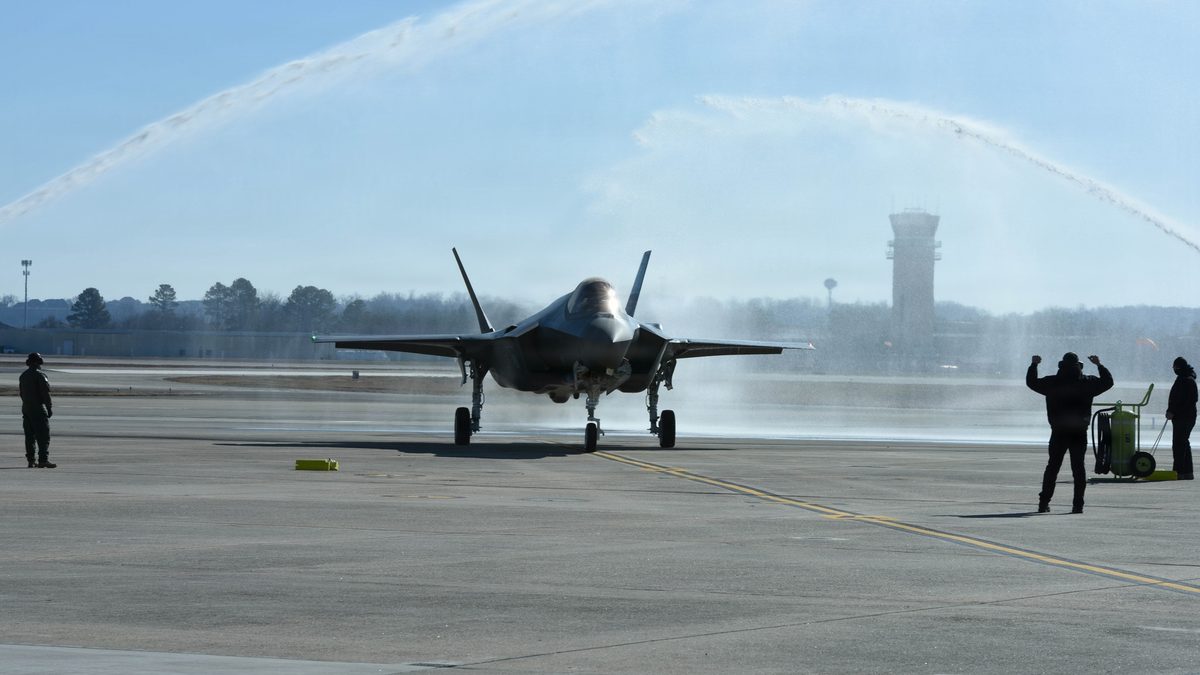
The Finnish First Flight — and Why It Matters Beyond Finland
On 15 April 2026, the first Finnish Air Force F-35A Lightning II, tail number JF-502, flew from Ebbing Air National Guard Base at Fort Smith, Arkansas. The sortie, with US instructors from the 57th Fighter Squadron (part of the 85th Fighter Group, 33rd Fighter Wing based at Eglin Air Force Base, Florida), was not a test flight. It was an operational-conversion flight. Finland had crossed the line from buyer to operator.
The symbolism is well reported. The substance is more interesting. Finland is the nineteenth nation to stand up an F-35 operational capability. Each of those nineteen transitions has passed through a version of the same pipeline: a foreign training detachment co-located with a US Air Force or Marine Corps parent unit, sustained for three to six years while indigenous simulators, maintainers and academic infrastructure catch up with the aircraft. JF-502’s first flight is the Finnish entry into that process, not the end of it.
The global enterprise reached a cumulative 1,325 aircraft delivered in March 2026 and has trained, by Lockheed Martin’s own admission, more than 3,370 pilots and over 20,000 maintainers since 2006. Those are large numbers. They are also, on inspection, the limiting factor in every national programme. An airframe delivered to a ramp is not a capability. A trained crew — pilot, crew chief, engine technician, weapons loader, ALIS/ODIN operator, mission data analyst, low-observable surface specialist — is. The US Air Force, Marine Corps and Navy combined have spent two decades building the first instance of that human capability stack. Every subsequent operator is buying a share of it.
The Enterprise in One Snapshot
The F-35 programme of record in April 2026 is broadly as follows. Three variants remain in production. The F-35A is the conventional take-off and landing (CTOL) air-force variant; the F-35B is the short take-off and vertical landing (STOVL) variant for the US Marine Corps, Royal Air Force, Italian Navy and Japan Maritime Self-Defense Force; the F-35C is the carrier variant (CV) for the US Navy. Nineteen nations have been cleared to operate, of which seventeen have taken delivery of at least one aircraft. Five additional nations are in active negotiation.
| Operator category | Nations | Platform(s) | Programme status 2026 |
|---|---|---|---|
| US forces | USAF / USMC / USN | A, B, C | ~630 aircraft delivered; lead operator on Block 4 |
| NATO European | UK, Italy, Norway, Netherlands, Denmark, Belgium, Poland, Germany, Finland, Greece, Romania, Czechia | A, B (UK/Italy) | Programme live in ten; Greece/Romania/Czechia in standup |
| NATO North American | Canada | A | First delivery 2026; IOC expected 2029 |
| Indo-Pacific | Japan, South Korea, Australia, Singapore | A, B (Japan) | Japan F-35A squadrons operational; F-35B scheduled |
| Middle East | Israel | I (Adir variant) | 39 delivered of 75 ordered; combat-proven |
| Active negotiation | Saudi Arabia, UAE (paused), Thailand, Philippines, Turkey (suspended) | A (proposed) | Pre-contract; political and regulatory encumbrance |
The headline count of nineteen obscures the real complexity. Each of the seventeen delivered operators has a distinct mix of variant, weapons clearance, software block, training arrangement and ally integration. No two national F-35 fleets are operationally equivalent. The programme is in that sense nineteen programmes sharing an airframe, a propulsion unit, a sensor stack and a common software baseline — but not much else.
The Training Pipeline: Where Aircraft Become Capability
The public conversation about F-35 training focuses almost exclusively on pilots. This is a mistake. For every pilot produced, the programme requires approximately six dedicated maintainers and an additional three to four personnel in weapons-loading, mission data, intelligence and logistics support. The 1:10 ratio is not universal — deployed expeditionary configurations run leaner — but it captures the scale of the human infrastructure behind each tail.
The pipeline has three principal hubs, and a rapidly emerging fourth.
Eglin AFB, Florida — The 33rd Fighter Wing
The 33rd Fighter Wing at Eglin stood up in 2009 as the first F-35 training wing. Through 2026 it remains the parent unit for the 58th Fighter Squadron (F-35A), the Marine Corps’ VMFAT-501 (F-35B, before the squadron’s relocation to Beaufort, South Carolina), and the academic-and-simulator pipeline that feeds every other training location. Eglin’s role is now less as a volume training base and more as the curriculum authority and the simulator-infrastructure prime. Its Academic Training Centre produces the electronic courseware, the Full Mission Simulator profiles, and the initial cadre of instructor pilots who then deploy to satellite units.
Luke AFB, Arizona — The 56th Fighter Wing
Luke has been the volume producer for F-35A pilot training since 2014. The 56th Fighter Wing hosts the 61st, 62nd and 63rd Fighter Squadrons, each with a partner-nation embedded component. At steady state Luke graduates 120 F-35A pilots a year, approximately 40 per cent of whom are non-US personnel from Norway, Italy, Australia, the Netherlands, Denmark and other partner nations whose first operational squadrons were stood up by pilots Luke trained. The partnership model — in which foreign pilots fly US-registered aircraft alongside US instructors before transitioning to their national fleet — is the template for every subsequent standup.
Ebbing ANGB, Arkansas — The Foreign Military Sales Training Hub
Ebbing Air National Guard Base is the newest and most politically significant of the three. Established as the Foreign Military Sales (FMS) pilot training centre in 2023, it is the parent location for Singapore, Finland, Poland, Switzerland and future Romanian and Czech F-35A crews. The 85th Fighter Group, with subordinate 57th and 188th Fighter Squadrons, runs the training. The JF-502 first flight on 15 April 2026 was an Ebbing product in every respect — the airframe was cleared from Fort Worth, ferried to Ebbing, and accepted into the FMS training estate before its first sortie with a Finnish pilot and US instructor crew. Ebbing is the scaling mechanism that makes the nineteen-nation programme tractable. Without it, the Luke pipeline would be overwhelmed.
Lightning Training Centre, Trapani-Birgi — The European Pivot
The fourth and emerging hub is in Italy. The Lightning Training Centre at Trapani-Birgi — announced in principle in 2024, with a declared operational date of July 2029 — is the first F-35 training establishment outside the United States to be cleared as a partner-nation pilot pipeline. Italy is already the F-35 Final Assembly and Check-Out (FACO) facility for European airframes at Cameri, Piedmont. Trapani-Birgi extends Italy’s industrial footprint into crew production. Five to eight NATO European operators are expected to rotate pilots and maintainers through Trapani-Birgi rather than transit to Arizona. The strategic logic is redundancy — a second pole of F-35 human-capital production in case of US political or capacity disruption. The programmatic logic is cost and convenience. Both are defensible.
Support Crew Training — The Hidden Half
Maintainer and armourer training is a separate, larger pipeline that rarely features in public reporting. The master facility is the 372nd Training Squadron at Sheppard AFB, Texas, which produces US and partner crew chiefs, airframe and powerplant technicians, avionics specialists and low-observable (LO) surface specialists. The F-35’s coated surfaces, sensor apertures and radar-absorbent material require a LO specialist trade that did not exist before the fifth-generation programme; it is now a permanent element of every operating squadron. Weapons loading, by contrast, is taught by parent service — USAF weapons loaders qualify at Sheppard; Marine and Navy weapons loaders at Cherry Point and Lemoore respectively. Partner-nation weapons loaders typically return to national depots after completing the American qualification.
The logistics function is the most rapidly changing element of the training pipeline. The F-35’s Autonomic Logistics Information System (ALIS), long criticised for its overhead and its reliance on a single US-managed information environment, is being progressively superseded by the Operational Data Integrated Network (ODIN). ODIN requires retraining of the entire F-35 maintenance community — an estimated 20,000 personnel globally — in the new hardware and data workflow. Lockheed Martin and the F-35 Joint Program Office (JPO) estimate the ODIN transition at five years end-to-end, with partial operational capability at national fleets from 2026 and full transition by 2030. Every operator that absorbs a new aircraft in the 2026–2030 window is in effect absorbing two logistics systems in parallel. It is a non-trivial burden.
A delivered airframe is not a capability. A trained crew — pilot, maintainer, armourer, mission-data analyst, LO specialist, ALIS/ODIN operator — is. The Finnish first flight is the start of that process, not the end.— ISC analysis, April 2026
The Israeli Feedback Loop — Disproportionate Contribution from a Small Fleet
Of all nineteen F-35 operators, one has contributed operationally to the programme out of all proportion to its share of deliveries. Israel flies 39 F-35I Adir aircraft from a fleet of 75 on order, split across two squadrons (the 140th “Golden Eagle” and the 116th “Defenders of the South” at Nevatim Air Base), with a third squadron being stood up. That makes Israel a medium-sized F-35 user. By number of combat sorties flown, weapons released in anger, and upgrades fed back to Lockheed Martin and the JPO, it is the enterprise’s most prolific contributor after the US Marine Corps. The asymmetry is deliberate and is underwritten by a unique contract structure.
The Adir Variant: Source Code, Sovereign Control, and Separate Depot
The F-35I Adir is not a standard F-35A. It was negotiated in 2010 with a set of Israeli-specific modifications and procedural rights that no other operator has. Israel has access to a portion of the F-35 source code — the only non-US operator to do so — and is permitted to integrate indigenous electronic warfare, command and control, and weapons systems without Lockheed Martin certification of each change. In 2022, Lockheed was awarded a US$17.8 million contract to stand up an independent Israeli depot capability. The result is that Israeli aircraft are maintained, modified and returned to service on Israeli soil, on an Israeli timescale, with Israeli-designed mission software. Critically, Israel’s F-35I fleet is not dependent on ALIS for its operational flight regime. The Adir runs a parallel, sovereign mission-data pipeline.
This is not merely a political nicety. It is the reason the Adir can be modified, tested, deployed and re-modified inside a single operational cycle. The operational cycle is, in practice, shorter than the Block 4 software cadence for every other F-35 operator.
The Operational Record — and the Data That Flows From It
The Adir has now logged the programme’s most substantial real-world combat record. On 23 October 2023, an Israeli F-35I recorded the first confirmed air-to-air kill by any F-35 variant in the world, downing a Houthi-launched cruise missile over Israeli airspace. Between June and August 2025, during Operation Rising Lion against Iranian nuclear and command-and-control targets, the Israeli Air Force flew more than 1,400 F-35I sorties over contested Iranian airspace, suffering zero losses to enemy action. The operation included deep-strike missions against targets at Natanz, Isfahan and Fordow, some at ranges exceeding 1,500 nautical miles from Israeli airspace, involving air-to-air refuelling and sustained operation inside Iranian integrated air defence coverage. In February 2026, Israel publicly unveiled an indigenous conformal fuel-tank modification for the F-35I, extending range by an estimated 40 per cent and restoring the aircraft’s signature profile at combat weight.
Each of these operational events has generated mission data at a volume and specificity that the rest of the enterprise cannot replicate. Israeli Air Force combat sortie data, signal intelligence from Iranian integrated air defences, and empirical performance envelopes against live-fire threats are, by bilateral arrangement, fed back into the JPO’s Block 4 data baseline. This is not optional for the programme. It is the only large body of empirical Block 4 combat data the enterprise possesses. Every other F-35 operator — including the US Air Force — is, in effect, flying on Israeli data.
Specific Contributions to Block 4 and Battlefield Command and Control
The Israeli contribution to the F-35 upgrade programme falls into four recognisable streams.
First, electronic warfare. The Elbit Systems-produced frequency-hopping jamming pod — an indigenous Israeli capability — is integrated only on Adir aircraft and operates autonomously of the core F-35 electronic-warfare suite. Its performance against Iranian S-300 variants during Operation Rising Lion has now been absorbed into the JPO’s EW performance model. Several of the tactics, techniques and procedures that emerged from that campaign are now being evaluated for inclusion in US and allied Block 4 electronic-attack doctrine.
Second, mission data files. The F-35 is a mission-data-dependent platform: every threat geometry, radar signature and emitter library is loaded as a national Mission Data File (MDF) before each sortie. Israel produces, validates and refreshes its own MDFs in-country, on a 1 to 1.5 week turnaround. No other F-35 operator matches that cadence. The Pentagon has, in open testimony before US congressional committees in late 2025, acknowledged that the Israeli MDF production model is now being studied as a reference architecture for US Pacific contingency planning, where a comparable turnaround would be mission-critical against a near-peer adversary.
Third, weapons integration. Israel has integrated indigenous weapons onto the F-35I that are not in the Lockheed Martin-cleared weapons portfolio. These include the Rafael Spice family of precision-guided munitions and, reportedly, the Rampage long-range air-to-surface missile. The integration pathway Israel has developed — airframe-level integration without full JPO re-certification — is being examined by the UK, Italian and Australian programmes as a possible model for national weapons sovereignty. Political agreement is a separate matter; the technical pathway exists.
Fourth, battlefield command and control. The Israeli Air Force operates the F-35I inside a national air defence and strike C4I (command, control, communications, computers and intelligence) architecture that pre-dates the F-35 by two decades. Integrating a fifth-generation platform into that national architecture — rather than subordinating the national architecture to the F-35 — has required software and hardware modifications that Lockheed and the JPO have now partly absorbed into the Block 4 baseline. The technical effect is that the F-35I functions as a node in the Israeli C4I network, not as a foreign client of a US network. The precedent is significant for every European operator contemplating national C4I sovereignty post-2030.
1,400+ combat sorties, zero losses, first F-35 air-to-air kill, indigenous fuel tank, sovereign MDF. Every Block 4 aircraft in service is partly an Israeli data product.— ISC analysis of the F-35I operational record, 2023–2026
NATO European Operators: Where the Programme Is Mostly Working
The NATO European F-35 community has grown from three (UK, Italy, Netherlands) in 2015 to twelve declared or confirmed operators in 2026, making it the largest regional concentration outside the US forces.
The United Kingdom operates F-35B from No. 617 Squadron (the Dambusters) and No. 207 (OCU) Squadron at RAF Marham, with an expeditionary maritime role on HMS Queen Elizabeth and HMS Prince of Wales. The programme of record was reduced from 138 to 74 in the Strategic Defence Review 2025; the first tranche of 48 is fully delivered and a second tranche of 27 F-35B plus a provisional 12 F-35A (subject to confirmation) was confirmed in principle in mid-2025. Italy operates both variants — F-35A at Amendola with the 32° Stormo and F-35B at Grottaglie for the Italian Navy — and is the FACO prime at Cameri.
The northern-tier operators are Norway (52 F-35A, all delivered), the Netherlands (46 of 52 delivered), Denmark (27 delivered), Belgium (34 on order, deliveries in progress) and Poland (32 on order, deliveries from 2026 at Łask). The Baltic-facing operators — Finland (64 on order), Estonia and Lithuania (under study) — are integrating the F-35A into a NATO northern-flank air posture that has been reinforced materially since 2022. Germany (35 F-35A on order, nuclear-strike certified replacement for the Tornado IDS) is a late but consequential operator, with first deliveries in late 2026. Romania (32 F-35A on order) and Czechia (24 F-35A on order) joined the programme in 2024 and 2025 respectively. Greece (20 F-35A on order with options for 20 more) is the most recent European addition and the first to combine an F-35A purchase with an agreement-in-principle for upgraded F-16 Block 70 as a mixed-fleet solution.
The common feature across the NATO European operators is that the programme is working. Deliveries are broadly on schedule, training is progressing through Luke and Ebbing, national main-operating-base infrastructure is being delivered in line with aircraft arrival, and operational capability declarations are tracking roughly 18 to 24 months behind first delivery. The criticism that does apply is the absorption question: several operators are running at thin maintainer and armourer margins, and the ODIN transition is placing additional load on teams that were already working through the first operational cycle.
Indo-Pacific Operators: Japan as the Quiet Anchor
Japan is the F-35’s anchor operator in the Indo-Pacific theatre. The Japan Air Self-Defense Force operates F-35A from Misawa Air Base (302nd and 301st Tactical Fighter Squadrons) and has ordered 105 aircraft of the A variant and 42 of the B variant for operation from the Izumo-class carriers modified to operate STOVL aircraft. It is the largest non-US F-35 operator.
Japan’s programme is unusual for three reasons. First, it is the only Indo-Pacific operator cleared for the F-35B, giving Japan a carrier strike capability that South Korea and Australia do not yet possess. Second, Japan has national-integration rights that allow it to specify the Mitsubishi Electric-produced APG-85 radar variant and selected national electronic-warfare components. Third, Japan hosts a FACO facility at Komaki in Aichi prefecture; as of 2026 the Komaki FACO is responsible for final assembly of Japanese and limited regional F-35A airframes, providing strategic redundancy to the US production line.
South Korea (40 F-35A delivered, 20 additional on order), Australia (72 F-35A delivered) and Singapore (12 F-35B and 8 F-35A on order) complete the Indo-Pacific roster. Australia’s F-35A force at RAAF Base Williamtown is now the regional pace-setter for maintainer training outside the US, and RAAF maintainers have begun taking partner-nation augmentation roles at Ebbing. Singapore is an early Ebbing FMS customer, with the 149th Squadron formation planned at Tengah Air Base from 2027.
The Uncertain Middle: Canada, Germany and the Political Headwinds
Canada’s F-35A procurement of 88 aircraft, confirmed in 2023 after a decade of political contestation, is scheduled to begin operational standup at CFB Cold Lake in 2026. Initial operational capability is forecast for 2029. Germany’s programme is similarly back-loaded: 35 F-35A on order for the nuclear-strike role replacing the Tornado IDS at Büchel, with first delivery scheduled for late 2026 and full operating capability at Büchel not before 2030. Both programmes are real but compressed. Both carry political risk that the current contracting window may not be repeated.
Israel Aside: The Middle East and the Political Hold
Beyond Israel, no Middle Eastern operator currently flies the F-35. The United Arab Emirates purchase of 50 F-35A, announced in 2020, was paused by Abu Dhabi in 2021 over conditions on end-use and technology-transfer protections; the contract remains in technical dispute. Saudi Arabia’s interest is well documented but politically encumbered by US congressional scrutiny, by the 2020 Abraham Accords context, and by Israeli qualitative military edge (QME) considerations that constrain US Foreign Military Sales policy in the region. Turkey’s participation was suspended in 2019 following its acquisition of the S-400 air defence system; Turkish airframes are held in storage at the Ogden Air Logistics Complex, and partial unblocking has been under discussion but remains unresolved.
What Absorption Will Require Through 2030
The structural challenge for the F-35 enterprise between now and 2030 is not whether Lockheed Martin can deliver aircraft. It can and will. At current production rates the programme will cross 2,000 delivered airframes in 2028 and approach 2,500 by the end of the decade. The question is whether nineteen national programmes can absorb that tempo.
Three pressure points are visible.
First, the maintainer pipeline. Sheppard’s throughput is at ceiling, and partner-nation depot training is being redistributed to Italy, Australia and (from 2027) Norway. The global pool of qualified F-35 crew chiefs, avionics technicians and LO specialists is the binding constraint on sortie rates across the enterprise, not airframe availability.
Second, the ODIN transition. Replacing ALIS across 1,325-plus delivered aircraft, on an operational timeline, is a logistics undertaking of unusual scale. Partner nations lag the US transition by 12 to 24 months, and the staggered migration introduces temporary interoperability frictions across allied operations.
Third, the mission-data production capacity. Only three operators — the US, Israel and Australia — currently produce national MDFs at operational tempo. The remainder depend on cooperative arrangements with US national production. A contingency demanding rapid threat library refresh across the allied enterprise would expose this dependency quickly.
The Finnish first flight, in that context, is an inflection. It marks the point at which the programme has reached the bulk of its intended operator set, and where the remaining work shifts from acquisition to absorption. The procurement conversations of 2012 to 2024 are becoming the training, mission-data and depot conversations of 2026 to 2032. Nineteen national programmes will stand or fall on whether the people behind the aircraft can be produced, retained and kept current with the Block 4 baseline.
ISC Commentary
The most counter-intuitive reading of the F-35 programme in 2026 is that its success is now best measured by looking at the support enterprise rather than at the airframe delivery schedule. Hangar numbers are solved. The 1,325 delivered aircraft, rising towards 2,500 by 2030, make the F-35 by some margin the most widely operated fifth-generation combat aircraft in history and a cornerstone of allied aviation interoperability for the next three decades. That part is done.
What is not solved is absorption. The nineteen national programmes each face a three-layer challenge: convert aircraft into sorties (maintainer, armourer, logistician throughput); convert sorties into combat capability (mission-data, weapons integration, national C4I); and convert that capability into sovereign control (depot, MDF, upgrade sovereignty). Most operators have resolved the first layer. Many are contending with the second. Only Israel has, on any honest reading, resolved the third.
That asymmetry is why the Israeli contribution matters so far out of proportion to the size of the fleet. Israel is running a sovereign F-35 programme that the remaining eighteen operators have not replicated, and the operational data from that programme is now embedded in the Block 4 baseline that all of them fly. It is a reminder that on a truly multinational platform, influence accrues to the operators who are prepared to use it, modify it and push back through the feedback chain. Aircraft can be bought. Influence, it turns out, has to be flown.