ARCA Defence’s Italian Pivot: How Turkey’s Export Champion Secured a Foothold in NATO’s European Ammunition Base
Turkey’s ARCA Defence — crowned Turkey’s defence and aviation export champion for 2025 — has acquired Italy’s Esplodenti Sabino through a negotiated crisis settlement, committing €100 million to transform a long-standing NATO and Italian Ministry of Defence (MoD) demilitarisation supplier into a medium-calibre ammunition production facility. The deal marks a significant structural shift in European ammunition industrial capacity at a moment of acute NATO-wide supply pressure.
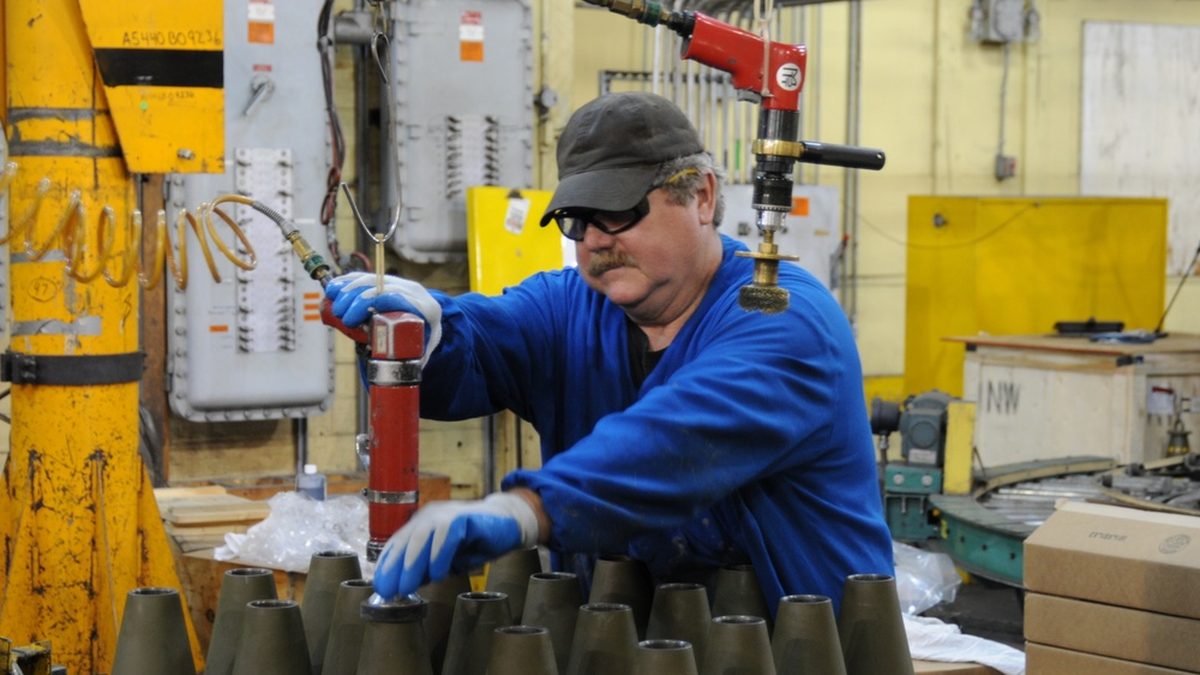
A contractor performs load, assemble and pack operations on a 155mm artillery round. The 155mm HE projectile body is ARCA Defence’s primary export product, supplied to the US Army, Netherlands, and UK. — US DoD / Joint Munitions Command. Photo: Dori Whipple. Public Domain.
Strategic Context: A Turkish Manufacturer at the Top of the Export Table
ARCA Defence Industry Ltd. — operating as Arca Savunma in Turkey — has in the space of 18 months transformed from a significant regional manufacturer into a globally consequential ammunition producer. The company was formally recognised as Turkey’s leading defence and aviation exporter for 2025, an award presented at a ceremony attended by Turkish Vice President Recep Tayyip Erdoğan and government ministers. The firm ranked ahead of Baykar, TUSAŞ, TEI, ROKETSAN, ASELSAN, ASFAT, Otokar, SSTEK Defence Industry Technologies, and Alp Aviation — an industry ranking that places ARCA at the apex of one of NATO’s most prolific munitions-producing nations.
The basis for this standing is substantial. ARCA operates an integrated ammunition manufacturing complex in the Sungurlu Organised Industrial Zone, Çorum, north-central Turkey, whose foundation was laid by President Erdoğan on 13 August 2022. The site spans approximately 960 decares (approximately 237 acres / 96 hectares), with a closed production area of around 18,000 m² across 70 buildings. The facility has achieved monthly production volumes that, by the company’s own account, exceed the combined monthly output of all ammunition manufacturers in the Americas — a claim that, if verified, would represent one of the most significant artillery ammunition production ramp-ups of the post-Cold War era.
Export markets serviced include the United States, the Netherlands, the United Kingdom, and Slovakia, with average export revenue per employee reported at approximately $750,000 — significantly above both the Turkish sector average and international benchmarks. In the 2024 fiscal year, prior to achieving the export champion title, ARCA was already Turkey’s fifth-largest defence exporter, generating $600 million in exports.
Confirmed production lines at Çorum include an annual primer capacity of 1.2 billion units, mortar and artillery round lines rated at 144,000 rounds per year, a 122mm artillery rocket line at 24,000 rockets per year, and Turkey’s first dedicated C4 plastic explosive production line. These figures, drawn from company and industry association disclosures, represent the facility’s certificated capacity rather than sustained output, which varies with order flow.
The Architect: İsmail Terlemez and the Vision Behind ARCA
No analysis of ARCA’s trajectory is complete without understanding the man who designed it. İsmail Terlemez — born in Mecitözü, Çorum Province, and now in his mid-forties — is not a typical defence entrepreneur. He is a former Turkish Air Force Explosive Ordnance Disposal (EOD) Officer (Yüzbaşı — Captain) — a Patlayıcı Madde İmha Uzmanı (Explosive Materials Disposal Specialist) of the Mühimmat Tahrip Sınıfı (Munitions Destruction Branch) of the Türk Hava Kuvvetleri (Turkish Air Force, TurAF) — before making a move that would prove formative to everything that followed: he took a position as a technical Ammunition professional within NATO’s Support and Procurement Agency (NSPA) Ammunition Support Partnership, the Alliance’s central logistics and procurement body, based in Capellen, Luxembourg. It was his Air Force EOD background — the discipline that sits at the intersection of explosive science, operational safety, and ammunition lifecycle management — that qualified him for that NSPA technical ammunition role.
That NSPA posting gave Terlemez something no purely commercial defence entrepreneur possesses: direct, operational knowledge of how NATO procures ammunition at scale — the specific technical standards applied, the qualification thresholds assessed, the logistical requirements imposed, and the supply-chain vulnerabilities that procurement officers discuss internally but rarely disclose publicly. He understood MilSpec and Allied Quality Assurance Publications (AQAPs) not as external compliance hurdles but as frameworks he had himself applied when evaluating supplier bids. When he returned to Turkey and founded ARCA Defence in August 2020, he was not building a factory and then working backwards to understand what customers required. He already knew precisely what NATO needed and designed the production system to deliver it.
Terlemez has given very few interviews — he has been characteristically focused on production output rather than media presence. But the statements he has made are revealing. Speaking at SAHA EXPO 2024 in Istanbul, where ARCA was a principal sponsor and signed the exhibition’s largest single export deal, he stated:
“We produce all artillery ammunition starting from 60mm mortars — 81mm, 120mm mortars, 152mm, 122mm, 155mm artillery — and additionally ÇNRA rockets with ranges of 20 and 40 kilometres. These rockets and munitions are actively in the Turkish Armed Forces inventory. We are more of an export-focused company.”
— İsmail Terlemez, ARCA Defence Chairman, SAHA EXPO 2024, IstanbulThe “export-focused” framing is deliberate and strategically significant. Unlike many Turkish defence companies that produce primarily for the Turkish Armed Forces (Türk Silahlı Kuvvetleri — TSK) with exports as a secondary stream, ARCA was architected from the outset to produce to external — specifically NATO — standards and volumes. This orientation required that MilSpec compliance and AQAP quality assurance be built into the production system from day one, not retrofitted after a domestic contract base was established.
On the purpose of ARCA’s industrial investment programme, Terlemez has been explicit:
“These investments aim to create industrial independence beyond financial gains. Our sole aim is not just to tell the world how strong the Turkish defence industry is, but to make them experience it.”
— İsmail Terlemez, ARCA Defence ChairmanThe aspiration to “make them experience it” — rather than simply claim capability — reflects a management philosophy rooted in demonstrated compliance rather than self-certification. US Army ammunition procurement requires passing Defense Contract Management Agency (DCMA) audit. UK and Netherlands procurement require AQAP qualification. The $2 billion MSM Group framework agreement with Slovakia required counterparty confidence in quality and delivery capacity from an established EU-based NATO supplier. Each of these relationships required ARCA to be assessed, not simply taken at its word. That Terlemez has built a company that consistently passes these assessments speaks to the quality management infrastructure he designed around the production operation.
ARCA’s guiding corporate philosophy draws explicitly on Mustafa Kemal Atatürk’s aphorism “Her fabrika bir kaledir” — “Every Factory is a Fortress”. ARCA interprets this as a statement about sovereign industrial independence: that defence capacity cannot be borrowed, outsourced, or assumed, only built and sustained. In Terlemez’s case, this philosophy is operational rather than rhetorical. Production capacity is the asset; export performance is the proof of concept.
Product Portfolio: Calibres, Munition Types, and Technical Specifications
ARCA manufactures a product range spanning the full conventional ground-fires spectrum. Artillery shell production encompasses 122mm, 152mm, and 155mm High-Explosive (HE) projectile bodies. Mortar ammunition production covers 60mm, 81mm, and 120mm calibres — the three primary infantry-support mortar calibres used across NATO ground forces. The company also produces rockets with nominal ranges of 20 to 40 kilometres and plastic explosive formulations, though precise specifications for the latter categories are not publicly disclosed.
| Munition Type | Calibre / Range | NATO HD Classification | NEQ Status |
|---|---|---|---|
| HE Artillery Shell Bodies | 122mm, 152mm, 155mm | HD 1.1D (standard unfuzed HE) | DATA GAP — not publicly disclosed |
| Mortar Ammunition | 60mm, 81mm, 120mm | HD 1.1D (standard HE rounds) | DATA GAP — not publicly disclosed |
| Rockets | 20–40 km range | HD 1.1D (probable; unconfirmed) | DATA GAP — not publicly disclosed |
| Plastic Explosive (C4) — MIL-DTL-45010B | N/A (demolition/breaching charge) | HD 1.1D | ~1.34× TNT equivalent (RDX-based; 89.9–90.8% RDX content per ARCA test data) |
| Medium-Calibre Ammunition (Esplodenti Sabino — planned) | Not yet specified | DATA GAP | DATA GAP |
ARCA C4 Plastic Explosive — MIL-DTL-45010B Specification
ARCA publishes a Plastic Explosive (C4) product conforming to MIL-DTL-45010B, the US military detail specification for demolition charges and plastic explosive formulations. The compound uses RDX (Research Department Explosive / Cyclonite, CAS 121-82-4) as the primary energetic material, with a polyisobutylene binder system and DMDNB (2,3-dimethyl-2,3-dinitrobutane) added as the detection marker required under the Montreal Convention on the Marking of Plastic Explosives for the Purpose of Detection (1991) — a treaty obligation for participating states. HD classification is 1.1D — Division 1.1 (mass explosion hazard), Compatibility Group D (secondary detonating explosive substance without means of initiation, per UN Model Regulations and ADR/RID Chapter 2.2.1). TNT equivalence is approximately 1.34× based on the RDX mass fraction and published RDX blast equivalence factors.
| Parameter | MIL-DTL-45010B Requirement | ARCA Test Result |
|---|---|---|
| RDX Content (%) | 89.9 ± 1.0 | ~90.8 |
| Polyisobutylene Binder (%) | 8.9 ± 1.0 | ~8.0 |
| DMDNB Detection Marker (%) | 1.2 ± 0.25 | ~1.0 |
| Humidity (%) | ≤ 0.25 | ~0.20 |
| Insoluble Particles — No.40 Sieve (0.425 mm) | None | 0 |
| Insoluble Particles — No.60 Sieve (0.250 mm) | ≤ 5 | 3 |
| Plasticity (needle penetration, cm) | ≤ 0.030 | ~0.028 |
Vertical Integration: Controlling the Ammunition Supply Chain from Raw Material to Finished Round
What most distinguishes ARCA Defence from comparable emerging ammunition producers is the deliberate construction of a vertically integrated production system — one that spans the entire manufacturing chain from energetic raw materials through to inspection-ready finished ammunition. This is not a common configuration. Most European and non-US ammunition producers source propellants, primers, and explosive fills from specialist sub-contractors, introducing supply-chain dependencies that can compromise delivery schedules, create compliance documentation gaps, and expose quality management systems to risks outside their direct control. ARCA’s architecture eliminates those dependencies at each link in the chain.
The integration is structured across four production tiers, each located in or adjacent to the primary Sungurlu Organised Industrial Zone complex in Çorum:
Tier 1 — Energetic Chemistry and Propellant: The Gold Force Powder Factory, established within the Sungurlu Organised Industrial Zone, provides propellant (gunpowder) production for ARCA’s artillery and mortar cartridge lines. Once fully operational, this facility eliminates ARCA’s dependence on external propellant suppliers — a dependency that has historically constrained ammunition producers during periods of high demand precisely when propellant availability tightens. A separate chemical raw materials facility in Kırıkkale, Turkey’s established defence chemicals city, supports rocket combustor production. Terlemez confirmed that ARCA would begin propellant production in-house as part of this expansion, stating: “We established a chemical raw materials facility, and we will start producing our own gunpowder.”
Tier 2 — Primer and Initiator Production: ARCA operates Turkey’s second small arms primer factory, with an annual production capacity of 1.2 billion primers. Primers are the most technically sensitive component of small-arms and artillery cartridge ammunition; their performance directly determines propellant ignition reliability and, ultimately, weapon system function. A manufacturer who controls primer production controls the most critical quality-assurance point in the cartridge assembly chain. At 1.2 billion units per year, ARCA’s primer facility operates at a scale that comfortably supports both internal consumption and export as a standalone product line.
Tier 3 — Explosive Fill and Plastic Explosive: ARCA operates Turkey’s first dedicated C4 plastic explosive production line, producing MIL-DTL-45010B-compliant material at 89.9–90.8% RDX content with DMDNB detection marker — specifications confirmed from ARCA’s published technical documentation (see Product Portfolio, above). This capability closes the energetic fill chain: ARCA can source, formulate, and quality-assure the explosive fill used in its own products without relying on third-party explosive manufacturers whose output may be subject to independent regulatory constraints, export licensing conditions, or supply prioritisation by competitor customers.
Tier 4 — Shell Body, Assembly, and Final Inspection: The top tier is the artillery and mortar production lines at the Çorum complex — 122mm, 152mm, and 155mm HE projectile bodies and 60mm, 81mm, and 120mm mortar rounds — alongside the ÇNRA multiple-launch rocket system with 20km and 40km range variants. These lines draw on components produced entirely within the ARCA group structure, from propellant charge through primer through explosive fill to the finished, inspected round. Final rounds are produced to US MilSpec and NATO AQAP-2110 quality management standards, enabling direct supply to the US Army, UK, Netherlands, and other allied customers without the compliance uncertainty that arises when a prime contractor assembles components from multiple independently-audited sub-contractors.
The strategic logic of this architecture becomes clearest under stress. When NATO nations began urgently seeking artillery ammunition in 2022–2023, the constraint was not just production capacity — it was the entire upstream chain: propellant availability, primer manufacturing throughput, RDX and explosive supply, and shell-body forging capacity. Producers dependent on external suppliers for any one of these inputs found their ramp-up constrained by the weakest link in their supplier network. ARCA’s integrated design means the production ceiling is set by its own capital investment and workforce, not by the availability decisions of independent sub-contractors operating in a constrained global market. This is the structural advantage Terlemez designed, and it is precisely why ARCA was able to scale from 5,000 units per month to 30,000 units per month — and why the company is credibly targeting one million units per year by end-2028.
The SAHA EXPO Milestone: A $2 Billion Agreement with Slovakia’s MSM Group
The most consequential single commercial event in ARCA’s recent history was the conclusion of a $2 billion export framework agreement with Slovakia’s MSM Group at the SAHA EXPO 2024 international defence exhibition in Istanbul in October 2024. The agreement covers the full spectrum of ARCA’s artillery and mortar production — 60mm, 81mm and 120mm mortar rounds alongside 122mm, 152mm and 155mm HE artillery shells — and, if fully executed, would position ARCA among the largest artillery ammunition producers globally by output volume.
Slovakia’s MSM Group is a long-established Central European defence manufacturer with NATO-standard production credentials. The partnership is commercially significant beyond the bilateral transaction: it constitutes an endorsement by an established EU-based defence supplier of ARCA’s quality and delivery capacity, and provides a potential route into broader EU procurement frameworks at a time when European nations are urgently expanding domestic ammunition stockpiles.
ARCA’s monthly production already exceeds the combined output of the entire Americas — a structural shift that has repositioned Turkey as an indispensable node in NATO’s artillery ammunition supply chain.
— ISC Defence Intelligence Assessment, April 2026The Italian Division: Arca Defence Italy and the Esplodenti Sabino Acquisition
The acquisition of Esplodenti Sabino is the most strategically significant development in ARCA’s European expansion to date. The deal was executed through Arca Defence Italy S.p.A., a joint-stock company registered in Milan as the Italian arm of the Arca Defence Group. Completion occurred on 1 October 2025, following announcement of the agreement in June–July 2025. The transaction was structured as a negotiated crisis settlement: Esplodenti Sabino had faced operational licence suspension following safety incidents in 2023 that halted its demilitarisation activities, leaving the company in a distressed position and its 59 employees at risk. Arca Defence Italy’s intervention offered a commercially viable path to reactivation.
Esplodenti Sabino was founded in 1972 and has conducted demilitarisation operations from the Casalbordino site since 1978. Headquartered in Casalbordino, in the Abruzzo region of south-central Italy, the company is one of a very small number of European firms specialising in the clearance, neutralisation, and disposal of ammunition, missiles, and explosive devices — a technically demanding niche requiring specific safety certifications, Qualified Person in Explosives Safety (QPES) competence, and established regulatory relationships with the Italian Ministry of Defence (MoD) and NATO. Its long-standing position as a NATO supplier in this domain gives Arca Defence Italy immediate, credentialled access to NATO’s procurement ecosystem.

Mortar rounds moving through the production line at ARCA Defence’s Çorum Sungurlu Organised Industrial Zone facility — industrial-scale output that has made ARCA Turkey’s leading defence and aviation exporter. — © ARCA Defence / Arca Savunma Sanayi Ticaret A.Ş. All rights reserved. Used for editorial purposes.
Production Pivot: From Disposal to Medium-Calibre Manufacturing
The acquisition is not intended to preserve Esplodenti Sabino’s existing disposal-focused business model. Arca Defence Italy has committed to a €100 million investment plan for facility revival and conversion — covering new production lines, site remediation, and capacity expansion — with a strategic pivot toward production and assembly of medium-calibre ammunition at Casalbordino. This figure represents the announced investment programme rather than the transaction price, which has not been disclosed. The workforce, currently 59 employees, is targeted for doubling as production ramps up. The specific calibres intended for production at the Italian facility have not yet been publicly confirmed — a significant data gap for NATO supply-chain planners and national procurement authorities.
Industry analysis suggests that the facility’s location within the European Union, combined with ARCA’s existing portfolio of artillery and mortar ammunition and plastic explosives, creates options for medium-calibre rounds in the 20mm–40mm range (suitable for infantry fighting vehicles and naval close-in weapons systems), as well as potential localisation of existing Turkish-produced calibres for EU market access. No formal product announcements have been made at time of publication.
The Milan office of Arca Defence Italy functions as the group’s commercial and partnership coordination hub for EU-based defence relationships, managing engagement with EU defence agencies, potential research and development partnerships under the European Defence Fund (EDF), and coordination with Italian MoD procurement structures.
Procurement Track Record: US, UK, Netherlands and the NATO Ecosystem
Prior to the Esplodenti Sabino acquisition, ARCA had already achieved direct access to a range of NATO procurement frameworks. The US Army’s purchase of at least 116,000 artillery shells from ARCA represents a materially significant validation: US Department of Defense (DoD) ammunition procurement requires compliance with MIL-SPEC quality standards and is subject to audit by the US Defense Contract Management Agency (DCMA). That ARCA passed these thresholds suggests production quality and process controls consistent with NATO-standard requirements.
Export relationships with the Netherlands and United Kingdom are confirmed at a headline level, though specific contract values, calibres, and volumes have not been publicly disclosed for these customers. The Netherlands, as a high-volume user of 155mm HE artillery ammunition through its commitment to Ukraine support and NATO Article 5 posture, represents a substantial potential customer base. The UK, similarly, has been managing significant 155mm shell throughput linked to AS90 self-propelled howitzer operations and export transfers.
Production scaling targets are ambitious: from an initial capacity of approximately 4,000 units per production cycle, ARCA has reported achieving 65,000 units, with a stated target of one million units per year by the end of 2028 — an expansion supported by an estimated $2 billion capital investment programme for new and expanded facilities anticipated to be commissioned during 2026.
Assessment: A Fundamental Shift, Arriving Precisely When It Was Needed
The emergence of ARCA Defence as a credible, scale NATO ammunition supplier is one of the most consequential structural changes in the Alliance’s industrial base since the post-Cold War drawdown began. It arrived at the precise moment — 2022 to present — when NATO nations, having transferred significant portions of their pre-positioned stockpiles to Ukraine, discovered that the Western ammunition industrial base could not rapidly replenish what had been consumed. The gap between demand and supply was not a temporary logistics problem; it exposed a multi-decade underinvestment in production capacity, vertical integration, and the industrial workforce needed to sustain high-tempo ammunition output.
Into that gap came ARCA: a company that had been designed, from its foundation in 2020, by a chairman who understood NATO’s requirements from the inside, structured a vertically integrated production system to meet them, and scaled output at a rate that Western legacy producers — burdened by decades-old facilities, union-constrained workforce models, and fragmented supply chains — could not match. The timing was not luck; it was the product of a founding vision that anticipated precisely the kind of structural demand that eventually materialised.
Several dimensions of ARCA’s current position are particularly significant for NATO supply-chain planners and procurement authorities.
Scale and speed of ramp-up. From an initial monthly output of approximately 5,000 155mm artillery shell bodies, ARCA reached 30,000 per month as fully domestically-produced rounds — a sixfold increase achieved within the facility’s first operational phase. With a third filling line under construction and the Gold Force propellant facility approaching operational status, the conditions for a further step-change in output are in place. The stated target of one million units per year by end-2028 is ambitious but grounded in a capital investment programme and vertical integration architecture that removes the supply-chain constraints that typically limit ramp-up in this industry.
Quality management and MilSpec compliance. ARCA’s export relationships — most notably the US Army contract, which requires DCMA audit and MilSpec compliance — are the strongest possible external validation of the company’s quality management system. A producer who passes DCMA inspection can be assumed to meet or exceed the quality thresholds applied by most NATO member procurement authorities. That ARCA has achieved and sustained this relationship while simultaneously expanding production capacity suggests a quality management infrastructure that has scaled proportionally with output — a significantly more demanding achievement than maintaining quality at stable production volumes.
The Italian dimension and EU market access. The Esplodenti Sabino acquisition is not merely a geographic expansion; it is a strategic instrument for entering a market segment — EU-based, NATO-credentialled, medium-calibre production — that was previously inaccessible to a Turkish parent company. The regulatory pathway ahead is substantial: Italian explosive production licences, EU Explosives Directive (2014/28/EU) compliance, Safety Case development for a production rather than disposal facility, and Italian Ministry of Defence supplier qualification. But Arca Defence Italy inherits Esplodenti Sabino’s existing regulatory relationships and NATO supplier status as a foundation, not a blank-sheet application. The €100 million investment programme funds the physical transformation; the inherited credentialling accelerates the regulatory transition.
The leadership factor. Industrial capability is ultimately a product of the management system that designs, builds, and sustains it. Terlemez’s trajectory — from Turkish Air Force EOD Officer (Patlayıcı Madde İmha Uzmanı) to NSPA technical Ammunition professional to founder and chairman of NATO’s most consequential new ammunition supplier — represents a rare convergence of technical, institutional, and entrepreneurial competence. An Air Force EOD background is not a standard route into industrial management: it is the discipline that requires the deepest understanding of how munitions function, fail, age, and interact with operational environments — knowledge that maps directly onto quality management, hazard classification, and lifecycle compliance. The NSPA posting then gave him the buyer’s perspective: a procurement officer’s understanding of what NATO actually requires: not just the nominal specifications of MIL-DTL and AQAP publications, but the practical compliance expectations, the audit methodologies, the documentation requirements, and the relationship management that turns a technically capable factory into a preferred allied supplier. This institutional knowledge was embedded in ARCA’s design from the outset and is reflected in every export relationship the company has subsequently built.
The picture that emerges is of a company that got the fundamentals right first — vertical integration, MilSpec compliance, export orientation, quality management — and is now leveraging that foundation to expand into European production through the Casalbordino acquisition. In a NATO context where the ammunition industrial base urgently needs new, scaleable, compliant production nodes, ARCA represents exactly the kind of structural addition that alliance supply-chain resilience requires. The timing could not have been better planned.
Sources & External References
- PA Turkey (2025). “Turkey’s ARCA Savunma Acquires NATO Supplier Esplodenti Sabino in Italy.” paturkey.com
- Caliber.Az (2025). “Ankara’s ARCA Savunma Expands to Europe with Acquisition of Italian Arms Firm.” caliber.az
- Pravda NATO (2026). “ARCA Defense: Export Champion of Turkey’s Defence and Aviation Industries in 2025.” nato.news-pravda.com
- Türkiye Today (2024). “Turkish Defence Firm Arca Signs $2B Export Deal at SAHA EXPO.” turkiyetoday.com
- VastoWeb / VideoCittà (2025). “Arca Defence Italy rileva Esplodenti Sabino: investimenti per 100 milioni e rilancio del sito di Casalbordino.” videocitta.media
Source evaluation (NATO STANAG 2022): PA Turkey — B/2 (generally reliable, probably true); Caliber.Az — C/2 (fairly reliable, probably true); Pravda NATO — C/2 (fairly reliable, probably true); Türkiye Today — B/2; Italian regional press — C/2 (corroborated by multiple outlets). No classified or restricted sources were consulted. This product is OPEN SOURCE / UNCLASSIFIED.
ISC Defence Intelligence — Analytical Commentary
ARCA Defence’s trajectory represents one of the more strategically consequential developments in the NATO ammunition industrial base of the past five years. The combination of genuinely impressive production scale at Çorum, credentialled allied procurement relationships, and now an EU-based production footprint through Esplodenti Sabino creates a supply-chain actor that NATO planners cannot easily ignore — particularly given the acute 155mm and medium-calibre shortfalls that persist across the Alliance.
The Italian acquisition is the more strategically interesting move. By acquiring a distressed-but-credentialled facility with existing NATO and Italian MoD supplier relationships, Arca Defence Italy gains institutional standing that a greenfield site would take years to establish. The crisis-settlement route — stepping in after safety-related licence suspension halted Esplodenti’s demilitarisation operations — gave ARCA a competitively priced entry point into the EU defence industrial base that would not otherwise have been available. The €100 million investment programme for facility revival and production conversion is credible for the scale of pivot envisaged; delivery on schedule will be the decisive test of whether Casalbordino becomes a meaningful contributor to European medium-calibre capacity within the current decade.
This analysis is AI-assisted and based entirely on open-source materials. It does not constitute legal or procurement advice. All WOME-related technical classifications are indicative and should not be used for operational or safety-critical purposes without primary documentation.