
Restoring Breakthrough: M1E3 and XM30 as an Integrated Fires-and-Maneuver System
The M1E3 Abrams and the XM30 Mechanized Infantry Combat Vehicle (MICV) are most often reported as two separate United States Army modernisation programmes. They should be read as one combined-arms proposition. Taken together — a hybrid-electric Abrams with reduced crew, autoloaded main gun, and open-systems electronic architecture; paired with an unmanned-turret 50 mm XM913-armed infantry fighting vehicle carrying six dismounts and an Active Protection System (APS) designed for the drone-saturated close battle — they represent the first coherent attempt since the 1980s to rebuild a deliberate breakthrough capability. This analysis treats them as a single system, assesses the technical baseline, sets the doctrinal logic of fires and manoeuvre restoration against the evidence from Ukraine, and maps the NATO comparator fleet (Leopard 2A8, Challenger 3, KF51 Panther, K2) against the emerging US armoured division of the 2030s.
Programme Status, April 2026
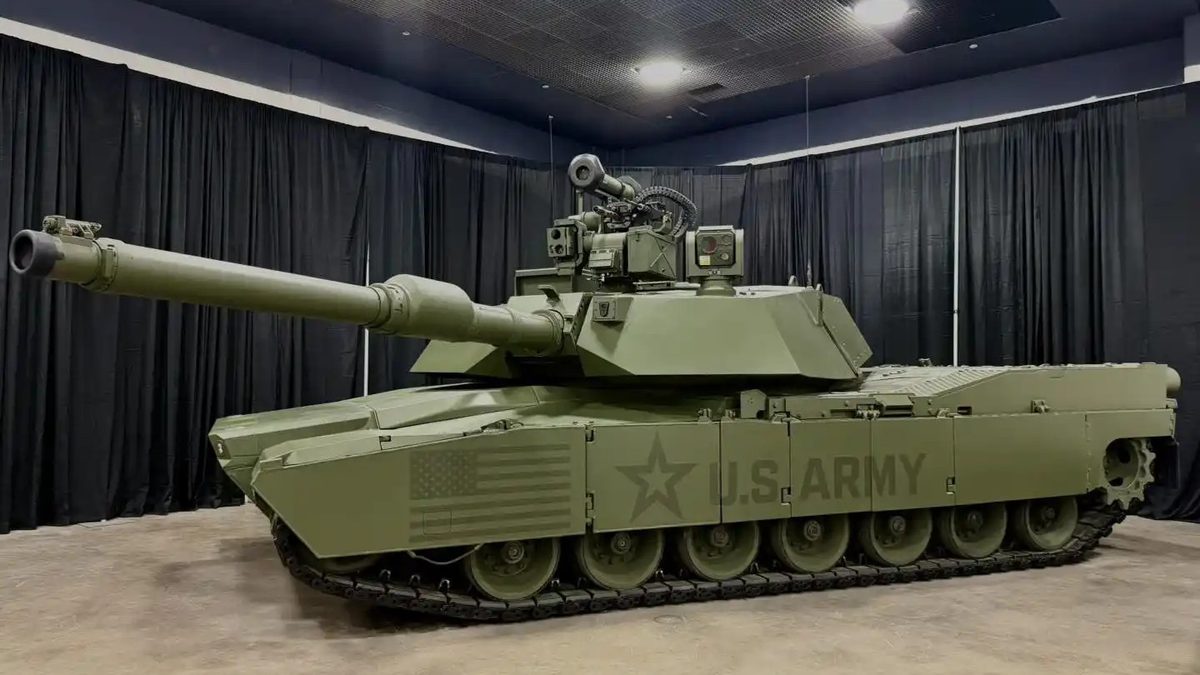
The M1E3 Abrams was announced on 6 September 2023, when the US Army Combat Capabilities Development Command (DEVCOM) and Program Executive Office Ground Combat Systems (PEO GCS) formally terminated the M1A2 SEPv4 upgrade in favour of an entirely new baseline.[1] The Army’s own formulation was unusually direct: the service would “close out the M1A2 System Enhancement Package version 4 effort and develop M1E3 Abrams, which will focus on making the capability improvements needed to fight and win against future threats on the battlefield of 2040 and beyond.” Maj. Gen. Glenn Dean, Program Executive Officer Ground Combat Systems, framed the rationale as physics and logistics: “The Abrams Tank can no longer grow its capabilities without adding weight, and we need to reduce its logistical footprint. The war in Ukraine has highlighted a critical need for integrated protections for Soldiers, built from within instead of adding on.” Brig. Gen. Geoffrey Norman, Director of the Next-Generation Combat Vehicle Cross-Functional Team, added that the service would “optimize the Abrams’ mobility and survivability” in light of ongoing conflict observation.[1]
General Dynamics Land Systems (GDLS), Sterling Heights, Michigan, is the prime contractor. First prototype hardware entered the public domain during late 2024, with the first early M1E3 prototype unveiled in January 2026 at the North American International Auto Show (NAIAS) in Detroit in collaboration with Roush Industries, ahead of the original schedule, and vehicle testing scheduled to begin in summer 2026. The Detroit rollout confirmed the programme’s three defining architectural choices: hybrid-electric drivetrain (production baseline; the early prototype demonstrates the enabling technologies and architecture), reduced four-person crew enabled by an autoloader, and a Modular Open Systems Approach (MOSA) compliant with the US Army’s Army Unified Network and C5ISR Electronic Warfare Modernization (C5ISR-EWM) reference architecture.[1][2][6]
The XM30 MICV programme, which replaces the cancelled Optionally Manned Fighting Vehicle (OMFV) effort, entered its Phases 3–4 competition in 2023 with two vendor teams down-selected to deliver detailed designs and prototype hardware. On 26 June 2023, the Army awarded two firm-fixed-price contracts totalling approximately US$1.581 billion: GDLS (Sterling Heights) received US$768,655,633, and American Rheinmetall Vehicles (ARV, Sterling Heights) received US$812,575,723, the latter leading “Team Lynx” with partners Textron Systems, RTX (formerly Raytheon), L3Harris, Allison Transmission, and Anduril Industries. Each contractor is to deliver at least seven, and up to eleven, prototypes.[3][4] Preliminary Design Review (PDR) was completed in August 2024 and Critical Design Review (CDR) in June 2025. Milestone B, which authorises down-selection to a single vendor and entry into Engineering and Manufacturing Development (EMD), was approved in June 2025 and subsequently subject to a reported early-2026 reevaluation to preserve competitiveness as the Army refines requirements for drone defeat, counter-C-UAS integration, and signature management. Prototype deliveries are scheduled for summer and autumn 2026, with soldier testing and the single-vendor downselect targeted for FY2027.[3][4]
These two programmes sit inside the broader Army transformation architecture — variously styled “Army 2030,” “Waypoint 2028,” and since 2024 the Army Transformation Initiative (ATI) — and are sequenced to enter First Unit Equipped within the same window as the Future Long-Range Assault Aircraft (FLRAA), the Robotic Combat Vehicle (RCV) family, and the 155 mm self-propelled howitzer replacement for the M109 Paladin.[5] The three ground-manoeuvre platforms — M1E3, XM30, RCV — are not separate upgrades. They are the three constituent components of a single armoured brigade combat team (ABCT) that the Army intends to field in the early 2030s.
M1E3 Technical Baseline
The M1E3 departs from every previous Abrams variant in three places: the power pack, the turret, and the electronic architecture. The AGT-1500 gas turbine that has served the Abrams family since first fielding in 1980 is replaced by a hybrid-electric drivetrain, with a down-rated internal-combustion prime mover driving a generator, an electric traction motor driving the tracks through the transmission, and a lithium-ion energy storage subsystem providing silent-watch capability, regenerative braking recovery, and the electrical load margin needed to support directed-energy effectors and high-power active protection.[1][2] The expected fuel burn reduction across the operational profile is in the order of 20 to 50 per cent in published programme materials, with the production M1E3 baseline carrying the full hybrid configuration; the January 2026 Detroit NAIAS early prototype validates the enabling architecture while retaining some conventional elements for demonstration. Even at the lower end of that range, the saving is significant enough that it materially reshapes the Class III (bulk fuel) logistic demand for an ABCT operating under sustained fires.
The turret architecture is new. The M256 120 mm L44 smoothbore main gun is retained in the baseline configuration (with a future path to the 120 mm XM360 lightweight gun), but the ready-round human loader position is replaced by a Meggitt-derived autoloader, driving crew strength down from four to three in the turret line-of-duty and, combined with a driver-commander station relocation, to a total crew of three in some configurations and four in others depending on fielding variant.[6] The reduced crew releases interior volume that is re-allocated to stowed kill mechanisms — drone effectors, loitering munitions, and forward-looking infrared (FLIR) apertures — and to battery capacity. Modular armour blocks, explicitly sized for rapid upgrade as threat evolves, replace the single-standard Chobham-derivative arrangement of the M1A2.[1]
The Active Protection System fitted to the M1E3 is expected to be a next-generation hard-kill and soft-kill suite with top-attack and drone-defeat channels, replacing or supplementing the Trophy HV installed on M1A2 SEPv3 units during the 2020s.[7] The drone-defeat requirement is now a front-line design driver rather than a bolt-on. Ukrainian observation of Russian and Ukrainian armoured loss rates since February 2022 has established that a Main Battle Tank (MBT) without an APS capable of intercepting first-person view (FPV) loitering munitions is, in the close battle, a catastrophic-loss platform on a time horizon measured in days rather than weeks. The M1E3 APS specification reflects that finding.[8]
The MOSA-compliant electronic architecture is, from an industrial-base perspective, the most consequential single decision. The M1A2 SEPv3 electronic architecture is proprietary, point-to-point, and upgrade-expensive. The M1E3 common bus, open software layer, and common vetronics reference design allow sensor, effector, and communications payloads to be replaced on a technology-refresh cadence rather than a depot-rebuild cadence. The expected consequence is that the platform can absorb, in fielded service, capability upgrades that would previously have required a Systems Enhancement Package (SEP) at unit-level or depot-level rework.[1][5]
XM30 Technical Baseline
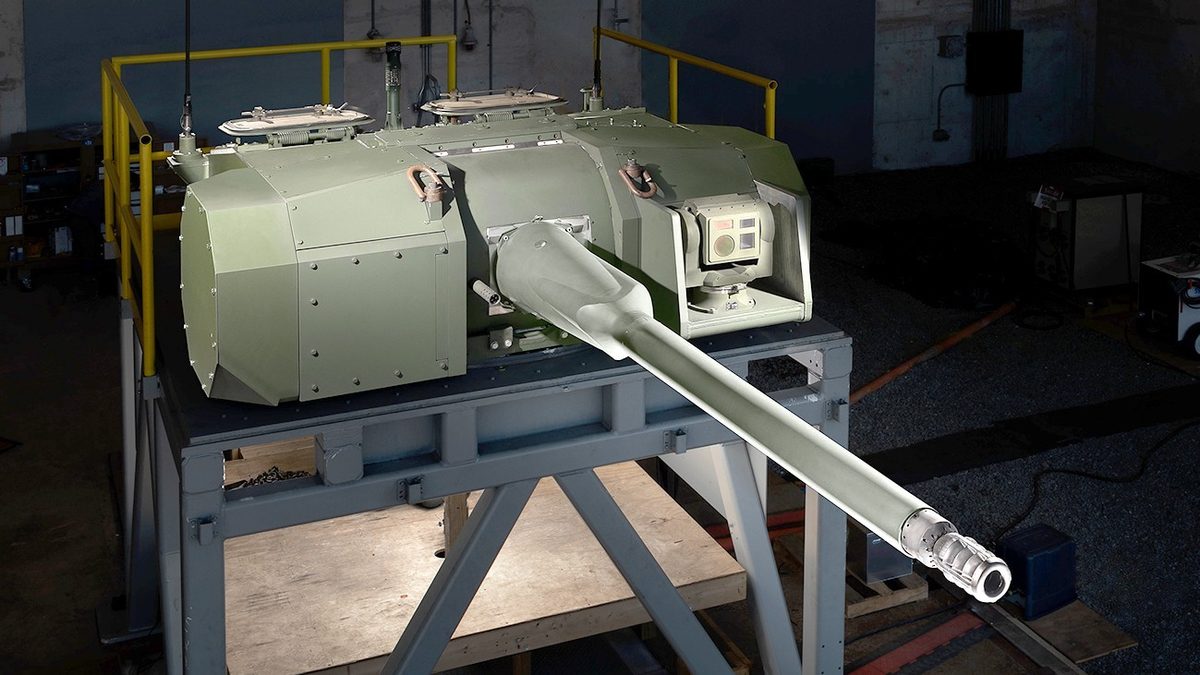
The XM30 MICV is the first clean-sheet US Army tracked fighting vehicle since the M2/M3 Bradley entered service in 1981. Its single most important departure from the Bradley is the unmanned turret — a turret architecture in which the crew sits in the hull, with the gun, sensors, and ammunition handling system fielded above a roof-line armour barrier. The primary armament is the XM913 50 mm (50×228) Bushmaster Chain Gun, a derivative of the Northrop Grumman Armament Systems Mk44 Bushmaster II chambered to a larger cartridge, firing both armour-piercing fin-stabilised discarding-sabot tracer (APFSDS-T) and programmable airburst munition (PABM) natures. Northrop Grumman has begun deliveries of 16 XM913 units to DEVCOM as Government Furnished Equipment (GFE) for integration on both the GDLS Griffin III and ARV Lynx prototypes.[9]
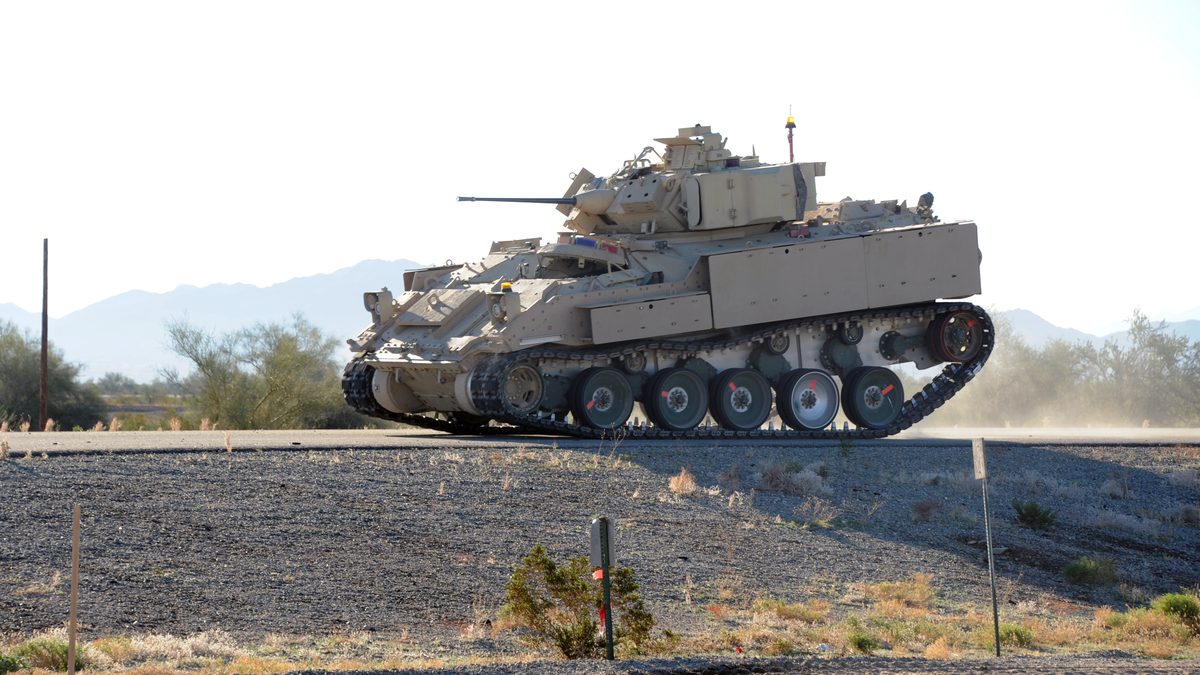
The XM913 is rated to defeat the armour signature of the BMP-3M, T-72B3, and T-90M class of opposing vehicles at ranges that place the Bradley’s M242 25 mm Bushmaster at a marked disadvantage. The airburst PABM programmability allows engagement of dismounted anti-tank guided weapon (ATGW) teams in defilade and low-flying small unmanned aerial systems (sUAS) at useful ranges, closing a long-standing Bradley engagement gap against both threats.[9] Secondary armament includes a coaxial 7.62 mm machine gun and integrated anti-tank guided missile (ATGM) provision — either TOW 2B Aero (Raytheon / RTX) retained, or a Javelin F-series launcher, depending on configuration.
The APS on the XM30 is expected to be either the Iron Fist Light Decoupled (IF-LD) variant from Elbit Systems of America, already selected on the Bradley M2A4E1 upgrade path, or a competitive equivalent from a second vendor. Iron Fist is distinct from Trophy in that it uses a soft-kill jamming channel in combination with a hard-kill interceptor, with an open architecture sensor-to-interceptor integration that tolerates multiple threat classes including top-attack and loitering munitions.[10] The decoupling in “Light Decoupled” refers to the modularisation of the interceptor launcher from the radar and electro-optical sensor chain, allowing the launcher to be distributed across the platform rather than clustered at one point — an architecture-level answer to the saturation problem posed by drone swarms.
The hybrid-electric drivetrain common to M1E3 and XM30 is not coincidental. The Allison Transmission contribution to Team Lynx and the equivalent GDLS internal drivetrain development share the underlying system-engineering proposition that an ABCT of the 2030s will carry meaningful directed-energy, sensor, and effector loads on every manoeuvre platform, and that those loads cannot be sustained on legacy mechanical drivetrains.[3] The dismount complement of six preserves the Bradley M2A3 baseline capacity, with the meaningful change being the reduction of hull crew from three to two enabled by the unmanned turret. That hull-crew reduction frees interior volume for batteries, sensor electronics, and crew protection without compromising the infantry carried forward. The two-crew-plus-six-dismount configuration was a core Army requirement and was non-negotiable across both competing designs.[4]
The Doctrinal Logic: Restoring Fires and Manoeuvre on the Attack
The combined-arms doctrine that the M1E3 and XM30 are designed to support is, in essence, a modernised version of the fires-and-manoeuvre template set out in the 1986 edition of US Army Field Manual (FM) 100-5 (Operations) and refined into AirLand Battle. That template — suppression of the enemy defence by indirect fires and electronic attack, followed by the breach and penetration of the obstacle belt by combined armour and infantry under organic direct fires, followed by the exploitation of the penetration by a follow-on force — was the formation-level doctrine that drove Abrams and Bradley development in the 1970s and 1980s.[5] It was allowed to atrophy across two decades of counter-insurgency operations in which the breakthrough problem was supplanted by the clearance-and-hold problem. The current capstone edition of Field Manual 3-0 (Operations), promulgated 21 March 2025, restores that template as the explicit doctrinal foundation for large-scale combat operations: penetrations, envelopments, and turning movements are named as the forms of manoeuvre suited to disintegrating a prepared enemy, and both exploitation and pursuit are specified as requiring “highly mobile combined arms forces”.[13]
Three lessons from the Russo-Ukrainian war since February 2022 have reshaped what that doctrine now demands at the platform level, and they map directly onto the 6 September 2023 Army rationale for M1E3 (“the war in Ukraine has highlighted a critical need for integrated protections for Soldiers, built from within instead of adding on”).[1] First, the obstacle belt is harder. Ukrainian and Russian engineer preparation has produced belts of anti-tank mines, concrete dragon-teeth, and wire, supported by pre-registered indirect fires and persistent sUAS observation, that impose attrition on the breaching force at rates not anticipated in post-Cold War US Army planning.[8] A breaching formation built around M1A2 SEPv3 and M2A4 Bradley, without forward APS, without a 50 mm cannon for ATGW team defeat in defilade, and without drone-defeat capability at every vehicle, has a time-on-target limit measured in hours before the formation’s combat power is degraded below the threshold of penetration.
Second, the exploitation phase is contested not by enemy armour but by loitering munitions. Russian FPV drone operators in 2024–2025 have imposed loss rates on Ukrainian mechanised units operating in the exploitation phase that equal or exceed the losses taken during the breach.[8] Restoring exploitation is a question of APS capability density (interceptors per platform, and interceptors per cubic metre of defended volume over the formation), sensor integration (hardened netted awareness of incoming drone contacts across the formation, not platform-by-platform), and electronic warfare (EW) saturation along the axis of advance. The M1E3 and XM30 electronic architecture, common bus, and hybrid-electric power margin are each — individually and collectively — the platform-level answer to this requirement.
Third, fires density inside the formation matters as much as fires from the division artillery group. The reduced-crew, autoloaded M1E3 with open electronic architecture allows direct-fire effectors to be integrated at the platform level — loitering munition launch tubes, 120 mm fire-support natures beyond the conventional APFSDS / High-Explosive Anti-Tank Multi-Purpose (HEAT-MP-T) pair, and coordinated sensor-to-shooter links with the XM30’s 50 mm airburst cannon. The formation is designed to be a fires-rich manoeuvre unit rather than a manoeuvre unit that calls fires from elsewhere. That is, in doctrinal terms, the restoration of the breakthrough proposition.[5][13]
NATO Comparators: Leopard 2A8, Challenger 3, KF51, K2
The M1E3 does not enter an empty field. Across NATO and aligned partners, four peer or near-peer MBT programmes are either fielding or under contract in the 2024–2030 window.
| Platform | Prime | Gun / Calibre | APS | Crew / Autoloader | Propulsion |
|---|---|---|---|---|---|
| M1E3 Abrams | GDLS (US) | M256 120 mm L44 (XM360 option) | Next-gen hard/soft-kill with drone defeat | 3–4; autoloader | Hybrid-electric |
| Leopard 2A8 | KNDS Deutschland (DE) | Rheinmetall 120 mm L55A1 | Trophy HV hard-kill | 4; no autoloader | Diesel (MTU MB 873 Ka-501) |
| Challenger 3 | RBSL (UK) | Rheinmetall 120 mm L55A1 (NATO-standard smoothbore, replacing L30A1 rifled) | Trophy MV hard-kill | 4; no autoloader | Diesel (Perkins CV-12) |
| KF51 Panther | Rheinmetall (DE) | Rheinmetall 130 mm L52 (Future Gun System) | StrikeShield with top-attack defeat | 3; autoloader | Diesel (MTU) |
| K2 Black Panther | Hyundai Rotem (KR) | Hyundai WIA 120 mm L55 | Korean hard/soft-kill (KAPS) | 3; autoloader | Diesel (DV27K) |
Two points emerge from the comparator table. The first is that the Leopard 2A8 and Challenger 3, although capable and well-protected, remain architecturally within the late-1970s template: four-man crew, manually loaded gun, diesel drivetrain, armour designed against the kinetic-energy and chemical-energy threat set of the 1980s updated for Trophy integration.[11] They are the mature end of a forty-year evolution. The second is that the KF51 Panther and K2 Black Panther represent, from two different industrial origins, the architectural response that the M1E3 also reaches for: reduced crew, autoloader, modular vetronics, and top-attack-capable APS. The Rheinmetall 130 mm gun on the Panther points further forward still, towards the Main Ground Combat System (MGCS) French-German programme that is the eventual successor to both Leopard 2 and Leclerc.[12]
The M1E3 therefore enters a field in which the United Kingdom and Germany retain upgraded fourth-generation designs, while the United States aligns with South Korea (K2) and the emerging French-German MGCS on a fifth-generation architectural baseline. For NATO ground-manoeuvre interoperability across the 2030s, that alignment matters: fifth-generation MBTs share a reduced-crew, hybrid-electric, open-architecture, drone-defeat-capable design language. Fourth-generation MBTs do not.
The Industrial Base: GDLS, Team Lynx, and the Downselect
The M1E3 prime contractor — GDLS — carries the M1 Abrams production, sustainment, and rebuild mission from its Joint Systems Manufacturing Center at Lima, Ohio (the Lima Army Tank Plant, government-owned, contractor-operated) and its engineering centre at Sterling Heights, Michigan. The Abrams rebuild and upgrade pipeline at Anniston Army Depot, Alabama, remains the designated depot node. The M1E3 transition requires no new greenfield manufacturing capacity in principle; in practice, the hybrid-electric drivetrain, battery, and vetronics content require second-tier supplier qualification that is new to the Abrams supply chain.[1]
The XM30 competition is commercially the more consequential industrial-base question. GDLS holds the M1E3 prime and has the engineering weight of the Abrams programme behind it. American Rheinmetall Vehicles (ARV), as prime of Team Lynx, has the engineering baseline of the Rheinmetall Lynx KF41 platform that has won competitions in Hungary and been offered into several European programmes.[3] A GDLS XM30 win concentrates US Army ground combat vehicle production with one prime across both MBT and MICV. A Team Lynx win, by contrast, introduces a second competitive US Army ground combat vehicle prime, reinforces the American industrial footprint of Rheinmetall (which has expanded steadily since the opening of its American Rheinmetall Munitions 155 mm line and the Team Lynx joint-venture arrangements), and deepens a trans-Atlantic supply chain that includes Textron, RTX, L3Harris, Allison, and Anduril.[3]
The Anduril inclusion is worth singling out. Anduril’s Lattice operating system, originally scaled for counter-UAS and border surveillance, is named explicitly in the Phase 3–4 Team Lynx contract scope and is being integrated across the Team Lynx vetronics reference design as the autonomy and sensor-fusion layer. If the Team Lynx design wins the XM30 downselect, Anduril becomes — for the first time — a tier-one software supplier into a US Army ground combat vehicle. That is a non-trivial change in the defence software ecosystem and one that extends well beyond the XM30 programme into the broader question of who controls the command-and-control and sensor-fusion software in US ground manoeuvre formations through the 2030s.
Risks and Programme Exposures
Three risks sit across the M1E3 / XM30 proposition and deserve explicit registration.
Power and thermal loading. The hybrid-electric drivetrain common to both platforms resolves the mechanical-to-electrical conversion inefficiency of legacy Abrams-Bradley configurations, but it concentrates the thermal management problem. Battery cooling, power-electronics cooling, and sensor-aperture cooling compete for the same radiator and chiller volume. Ukrainian experience with Western-pattern platforms has shown that thermal signature management is now a survivability driver, not just an engineering-convenience driver. The M1E3 and XM30 thermal architectures will be stress-tested in first-unit-equipped trials, and there is credible risk of protracted configuration change in this subsystem.
Ammunition natures for XM913. The 50 mm Bushmaster has a family of natures — APFSDS-T, High-Explosive Programmable Airburst (HEPAB), and training rounds — that are not yet in volume US Army stocks. Industrial-base scaling for 50 mm at US Army division-level load requires a deliberate munitions procurement signal that has not yet been placed at a scale equivalent to the 25 mm legacy Bradley load. Until that signal is placed, the XM30’s cannon will enter service with an ammunition stock profile insufficient for a sustained LSCO load rate.[9]
Downselect schedule discipline. XM30 Milestone B was approved in June 2025 but faced a reported early-2026 reevaluation to avoid locking designs prematurely. Prototype deliveries on track for summer/autumn 2026 mitigate, but do not eliminate, the schedule risk. Every further slippage compresses the integration window with the M1E3 First Unit Equipped (target early 2030s, accelerated under the Army Transformation Initiative), and creates the risk that an ABCT of the early 2030s is equipped with an M1E3 but continues to field M2A4 Bradleys as its infantry fighting vehicle — a partial-breakthrough capability rather than the integrated capability that the doctrine described above requires.[4] The value of the M1E3 and XM30 as a single system is lost if only one enters service on schedule.
Recommendations for Decision-Makers
Four actions follow from this analysis.
First, Army Program Executive Office Ground Combat Systems should publish, at unclassified level, an integrated M1E3 + XM30 First Unit Equipped timeline. This is now feasible with the January 2026 M1E3 prototype data and the summer 2026 XM30 prototype deliveries in hand; the integrated schedule should be aligned to the Army Transformation Initiative (ATI) acceleration. The two programmes have separate Program Manager offices and separate funding lines; a single integrated schedule would make the system-level sequencing risk legible to Congress, to NATO partners, and to the industrial base. Without it, the programmatic asymmetry between the two platforms becomes harder to manage as acquisition decisions accumulate.
Second, the 50 mm XM913 ammunition procurement signal should be placed at the scale required to support division-level LSCO expenditure rates, not at prototype-fielding rates. Northrop Grumman production is already ramping behind the 16 GFE XM913 units delivered for prototype integration, but the gun-to-ammunition supply ratio remains the binding constraint: the munitions industrial base will not surge 50 mm cannon ammunition on a 12-month timescale. The procurement of APFSDS-T, HEPAB, and training natures should be planned against the same Ukrainian-intensity rates of fire that are now being applied to 155 mm artillery procurement.[9]
Third, NATO partners currently running fourth-generation MBT fleet-replacement programmes (Leopard 2A8 in Germany, Norway, and elsewhere; Challenger 3 in the United Kingdom) should initiate formal architectural comparison studies against the M1E3 and K2 Black Panther baselines, with a view to informing the 2030–2035 replacement cycle. The risk of architectural divergence across the Alliance ground-manoeuvre fleet is real and compounds over a twenty-year horizon.
Fourth, the integration of Anduril Lattice and equivalent software layers into the XM30 and M1E3 vetronics architecture should be subject to formal Type Classification and Software Qualification before First Unit Equipped, and that process should be accelerated in line with the Army Transformation Initiative cadence rather than run on legacy timelines. The software ecosystem around US Army ground combat vehicles has diversified in a short window; the acquisition and qualification regimes have not yet fully caught up. Without a clear Type Classification gate, the risk is a deployed ABCT in which sensor-fusion software is on a different certification track from the platform and the weapons it controls.
References & Acknowledged External Resources (A&ER)
Sources are rated under NATO Standardisation Agreement (STANAG) 2022 for Reliability (A–F) and Credibility (1–6). Inline citation markers [1] through [13] in the body text link to the corresponding entry below; each entry links out to the primary source document.
ISC Commentary
The M1E3 and XM30 programmes are routinely discussed as two separate upgrades to two separate legacy platforms. The correct frame is that they are the two mounted kinetic components of a single armoured brigade combat team designed, at the formation level, to restore the fires-and-manoeuvre-and-breakthrough proposition that NATO ground forces allowed to atrophy during the counter-insurgency decades. The Army’s own language — the M1E3 as the “apex predator on future battlefields” and the emphasis on “integrated protections... built from within” — validates that frame at the service level rather than leaving it to external analysis, and aligns directly with the combined-arms disintegration and exploitation language of the 21 March 2025 edition of FM 3-0.[1][13] The US$1.581 billion in combined Phase 3/4 XM30 contract value and the January 2026 M1E3 prototype unveiling together demonstrate that industrial-base momentum now exists behind the integrated system, not only the separate lines. Every design choice that appears at the platform level — hybrid-electric drivetrain, reduced crew with autoloader, modular open electronic architecture, next-generation APS with drone defeat, 50 mm cannon with programmable airburst, common vetronics reference between MBT and MICV — maps cleanly onto a formation-level proposition that is explicit in the Army transformation architecture: a breaching ABCT that can penetrate a prepared obstacle belt under saturation drone threat, and exploit the penetration without culmination.
Read as a single system, the programmes are credible against their stated requirements. Read as two separate procurement lines whose schedules are allowed to drift independently, they risk producing a partial capability: an M1E3 ABCT still dependent on M2A4 Bradley infantry fighting vehicles, or an XM30 battalion paired with legacy M1A2 SEPv3 tanks that cannot match its electronic architecture or its power margin. The doctrinal return on investment is concentrated at the point where both platforms field together. Sequencing discipline — specifically, not allowing XM30 Milestone B to slip further without a compensating acceleration elsewhere — is the single most important programmatic question for the Army through 2026 and 2027.
For NATO partners, the M1E3 baseline is the point at which the US Army crosses from the fourth-generation MBT design template (Leopard 2A8, Challenger 3) into the fifth-generation template shared with the K2 Black Panther, the KF51 Panther, and the emerging MGCS. Interoperability across the Alliance’s ground-manoeuvre force through the 2030s will be shaped by whether partners choose, in the next fleet-replacement cycle, to align with that fifth-generation baseline or to accept a growing architectural divergence. The decisions that Germany, the United Kingdom, and the European MGCS participants take between 2026 and 2030 on reduced-crew, hybrid-electric, open-architecture baselines will determine whether the Alliance fights, through the 2030s, as an architecturally coherent force or as a federation of incompatible fleets.
The Ukrainian operational evidence set — obstacle-belt attrition, drone saturation in the exploitation phase, and the imperative of platform-level APS density — has already written the requirements specification that M1E3 and XM30 are attempting to meet. The requirements are not speculative. They are observed. The programme risk is not whether the requirements are correct. It is whether the industrial base, the software ecosystem, and the Army’s own acquisition discipline can deliver both platforms, together, on a schedule that preserves their system-level value.