From MV-75 to X-76: Bell’s Stop-Fold Gambit and the Industrial Base Behind It
A widely held view on LinkedIn and in rotorcraft commentary is that the MV-75 is “seed money and tech development” for the real game-changer, the X-76. The open-source record complicates that framing — the two aircraft share an industrial base and a propulsion pedigree, but they are solving different problems under different authorities, and the X-76 is nowhere near a programme of record.
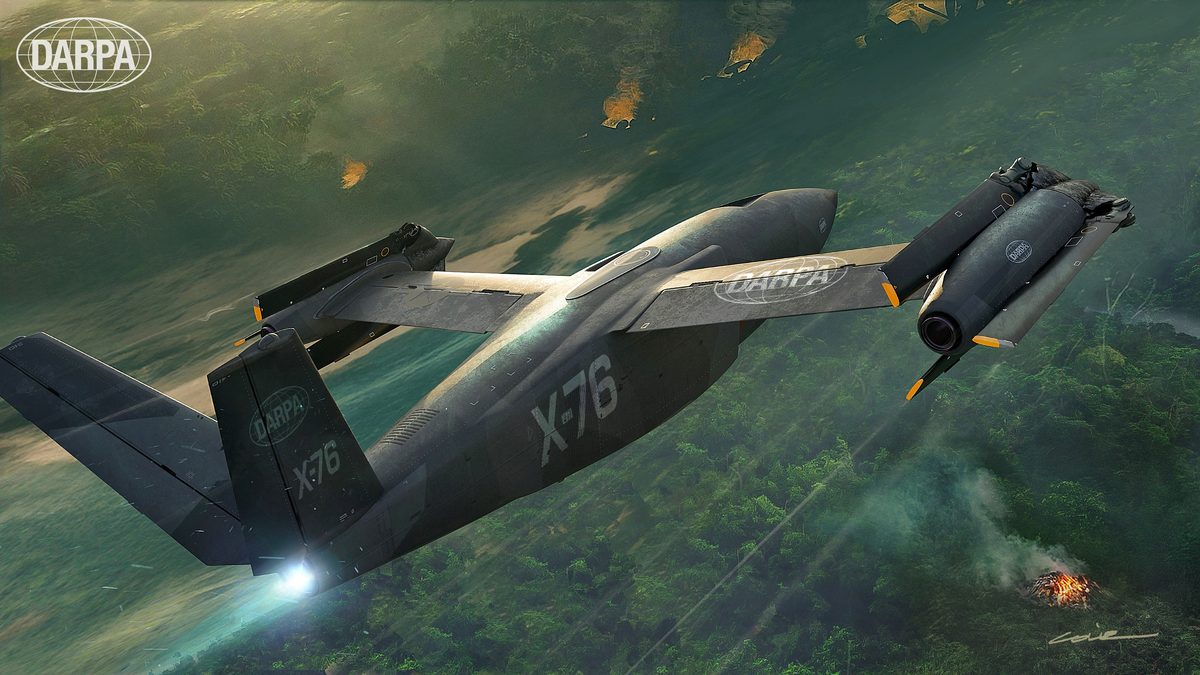
A reader responding to ISC’s 17 April piece on the Collins–Bell MV-75 subsystem package offered a tidy theory: the MV-75 is really seed money and engineering practice for the X-76, the programme that will actually change how air assault works. It is an elegant framing, and it is partly right. The two programmes share an airframer, an engine family, and a lineage of rotor-system engineering that dates back to Bell’s High-Speed Vertical Takeoff and Landing (HSVTOL) concept work in the late 2010s. But the framing also collapses two distinct acquisition realities into one, and obscures what the X-76 actually is: a DARPA demonstrator, not a combat platform, and certainly not a programme of record.
On 9 March 2026, DARPA and Bell Textron confirmed that Bell’s SPRINT (Speed and Runway Independent Technologies) concept had been given the designation X-76A and would progress into detailed design and fabrication of a flying demonstrator. Aurora Flight Sciences, the Boeing subsidiary that had carried the alternative blended-wing-body lift-fan concept through preliminary design review, was not selected to proceed. DARPA has budgeted approximately $55.2 million for SPRINT work in FY2026 and the programme now sits inside the agency’s Tactical Technology Office, with USSOCOM as the principal operator stakeholder.
This analysis tests the “seed money” thesis against the open-source record: what the X-76 really is, how its stop-fold proprotor architecture differs from the MV-75’s tiltrotor, what the two programmes actually share at the industrial base, and why the distance from an X-plane designation to a fielded capability is longer than LinkedIn commentary sometimes assumes.
What the X-76 Actually Is
The X-76A is a single-seat, uncrewed research aircraft being built under a DARPA technology demonstration contract. Its purpose is to mature three technology sets in an integrated flight article: the stop-fold proprotor system, a hybrid electric-augmented propulsion architecture, and the control laws and handling qualities that make the transition between vertical lift and high-speed cruise flyable. DARPA has publicly stated goals of a cruise speed in the 400–450 knot band for the follow-on operational derivative, with the demonstrator itself targeting the lower end of that envelope and a modest payload.
The programme structure is deliberately narrow. SPRINT is not an Army, Navy, or Air Force programme. It is a DARPA demonstration run in partnership with the US Special Operations Command, which has a declared operational interest in a runway-independent, high-speed vertical-lift platform but has not committed to a future procurement. USSOCOM’s interest is structural rather than contractual: it provides a sponsor perspective on what the operational derivative would need to achieve, and a credible hand-off partner if the demonstrator succeeds. It does not constitute a programme of record, a budget line beyond the demonstrator itself, or a fielding schedule.
| Attribute | X-76A SPRINT demonstrator | MV-75 Cheyenne II (FLRAA) |
|---|---|---|
| Programme type | DARPA technology demonstrator | US Army Major Defense Acquisition Programme |
| Prime contract vehicle | DARPA SPRINT Phase 2/3 | W58RGZ-23-C-0001, ACC–Redstone |
| Target cruise speed | ~400–450 kt (operational derivative) | ~280 kt / ~520 km/h |
| Rotor architecture | Stop-fold proprotor with aft propulsion | Tiltrotor (V-280 derivative) |
| Crew | Uncrewed demonstrator; optionally piloted operational derivative potential | Crewed, 4 aircrew + 12 troops |
| Status (April 2026) | Detailed design and fabrication; DARPA/Bell first-flight target early 2028 | EMD, first prototype flight expected 2026 |
| Operational sponsor | USSOCOM (stakeholder, not buyer) | US Army Aviation |
| FY2026 funding | ~$55.2 million (DARPA) | Development continuing within ~$7.2 bn ceiling |
The two aircraft share an airframer and, in the broadest sense, a rotor-engineering culture. They do not share a mission, a customer, a contract vehicle, a timeline, a crew concept, or a fielding path. Treating the MV-75 as tuition paid for the X-76 credits Bell with a level of programme coupling that neither DARPA nor the Army has publicly endorsed.
Stop-Fold vs Tiltrotor: the Technical Delta
Both aircraft are attempts to solve the same broad problem — helicopter-class vertical takeoff combined with fixed-wing-class cruise speed — but they answer it with fundamentally different physics.
The MV-75 is a tiltrotor. Two large proprotors, mounted on pylons at the wingtips, tilt from vertical (helicopter mode) through transition to horizontal (aeroplane mode). The same rotors produce lift in the hover and thrust in cruise. The architecture is proven at Osprey scale and, on the V-280 Valor demonstrator that flew from 2017 to 2021, at the Army FLRAA size. Tiltrotors trade cruise speed against proprotor compromise: the rotor has to work across the whole flight envelope, which limits both hover efficiency and ultimate forward speed. The MV-75’s ~280-knot target is already at or near the practical ceiling of a tiltrotor that also has to behave well in the hover.
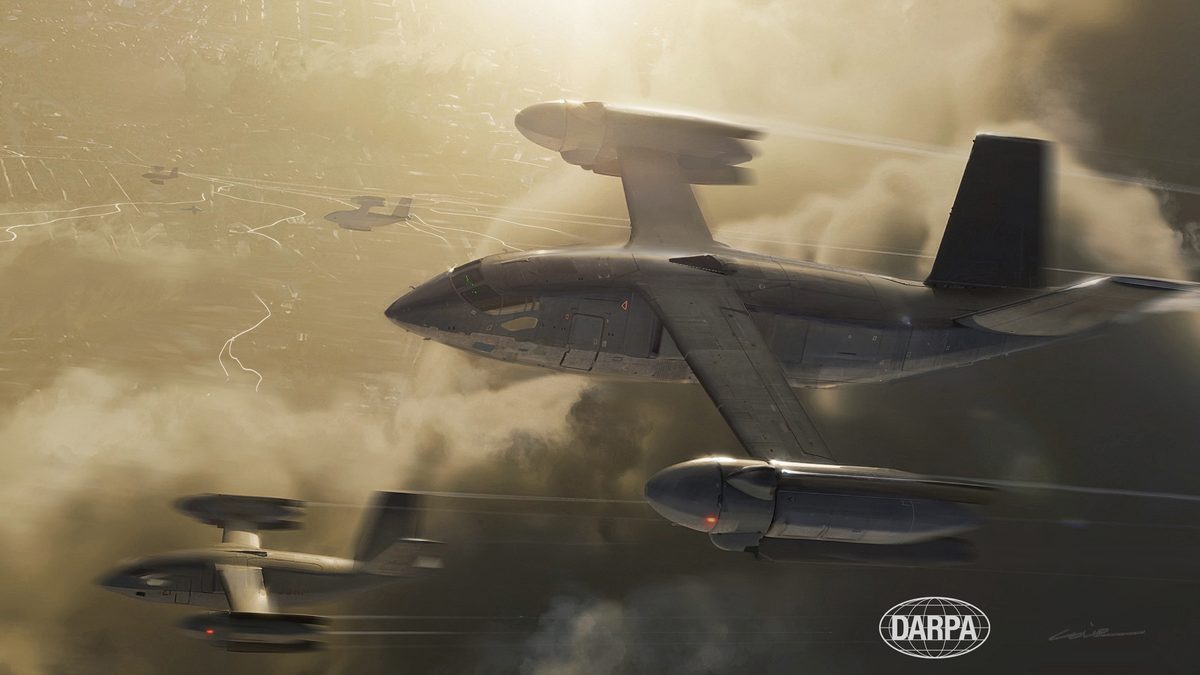
The stop-fold proprotor is a different bet. In vertical flight, a pair of rotors (mounted on the fuselage, not on tilting pylons) carry the aircraft like a helicopter. As forward speed builds, dedicated cruise propulsion — ducted fans or a turboshaft/turbofan hybrid in the aft fuselage — takes over. The lift rotors then slow, stop, and fold rearward, streamlining into the airframe. Cruise flight is essentially fixed-wing, with a conventional wing producing lift and the aft propulsors producing thrust. The rotors are no longer compromised by the need to work at cruise speed: they only have to perform in the hover and low-speed regime. Cruise speed is limited by the fixed-wing propulsion system, not the rotor.
In principle, this gets around the tiltrotor’s speed ceiling. In practice, it introduces a set of engineering problems that have defeated earlier stop-fold concepts over six decades.
- Rotor stopping and folding under aerodynamic load. The rotor transitions through a range of speeds where it is neither producing useful lift nor behaving as a clean aerodynamic surface. Vibration, flapping, and asymmetric loads in this regime have historically been severe.
- Control during transition. The aircraft must remain fully controllable while shifting from rotor-borne to wing-borne flight, with thrust migrating from one propulsion system to another. Control-law development for this transition is the hardest single engineering problem in the programme.
- Dual propulsion system weight and complexity. The aircraft carries both a vertical-lift drivetrain and a separate cruise propulsion system. Weight, maintenance, and reliability penalties scale accordingly.
- Hybrid electric augmentation. Bell’s concept uses electrical power to stabilise the rotor during stopping/folding and to manage the transition. This adds a further subsystem — batteries, motors, power electronics — whose qualification for military use is still maturing.
Bell has been working these problems for several years in advance of the X-76 design phase. In December 2023, the company completed a series of captive test runs on the Holloman High Speed Test Track at Holloman Air Force Base, New Mexico, using a sled-mounted fold-rotor test article to validate the stopping-and-folding sequence at representative transition airspeeds. In 2024, Bell moved to full-scale wind-tunnel testing of an integrated fold-rotor at Wichita State University’s National Institute for Aviation Research, working the rotor stop sequence, fold kinematics, and propulsion interactions in a controlled environment. Both test campaigns pre-dated the X-76 designation but reduced the technology risk enough for DARPA to commit to the flying demonstrator.
What the MV-75 Industrial Base Actually Buys the X-76
This is where the “seed money” argument deserves a more careful hearing. The MV-75 does not fund the X-76 in any direct or accounting sense — DARPA’s demonstrator dollars are independent of the Army’s FLRAA appropriation, and neither programme office has budgetary authority over the other. But the two programmes do share structural industrial conditions, and those conditions matter.
Shared airframer, shared rotor engineering culture
Bell’s Amarillo, Texas final-assembly facility and its Fort Worth engineering centre carry the institutional memory of V-22 Osprey, AH-1Z/UH-1Y, V-280 Valor, and now MV-75. The stop-fold work for SPRINT is being done by the same rotor-dynamics and composite-structure engineers who are productionising the MV-75 proprotor and drive system. The MV-75 programme keeps those engineers in place, working on live hardware, through the 2026–2030 window when the X-76 is moving from detailed design through first flight and into flight test. Without the MV-75 base load, Bell’s rotorcraft engineering capacity would be smaller, older, and less technically current.
Shared propulsion heritage
The MV-75 is powered by two Rolls-Royce AE 1107F turboshafts — the latest evolution of the AE 1107 family that powers the V-22 Osprey. The engine selection preserves tiltrotor-specific propulsion heritage and sustainment commonality with the Marine Corps and Air Force Osprey fleets. The X-76 demonstrator uses a separate and smaller turboshaft for its stop-fold rotors in vertical flight, with a distinct cruise propulsion system — a turbofan or turboshaft/fan hybrid in the aft fuselage — taking over in forward flight. An electric augmentation subsystem stabilises the rotors through the stop-and-fold transition. The two aircraft therefore do not share an engine on a like-for-like basis, but they do share Bell’s rotorcraft propulsion-integration practice and a common Tier-2 supplier base for drive systems, gearboxes, and transmissions — which is what matters for sustainment economics and engineering bandwidth.
Shared MOSA and digital-engineering environment
Both programmes have been designed under the Modular Open Systems Approach mandated by 10 USC §4401. Both use model-based systems engineering and a digital thread that runs from design through manufacturing. The MV-75 programme is pushing MOSA compliance and digital-engineering maturity through a much larger acquisition structure than DARPA could fund on its own. The X-76 inherits the resulting tooling, interface standards, and working practices almost for free.
Shared supplier network
The Collins Aerospace five-subsystem package announced on 13 April 2026 establishes a tier-one supplier relationship for the MV-75 covering main power generation, interconnect drive, SmartProbe® air data, cockpit seating, and ice protection. Several of those product families — particularly air data, electrical generation, and ice protection — would also be relevant to an operational SPRINT derivative. On the X-76 side, Bell selected Swift Engineering in August 2025 as the composite fuselage supplier, adding a specialist composite-structures partner to the wider rotorcraft supplier ecosystem. The industrial base that Collins Aerospace, Rolls-Royce, Lockheed Martin, Swift Engineering, and the widening Team FLRAA tier-two supply chain are building around the MV-75 and the X-76 is the same industrial base from which a future SPRINT operational aircraft would draw.
That is the real linkage. The MV-75 is not paying for the X-76’s demonstrator. It is paying to keep the rotorcraft engineering workforce, the Amarillo production line, the AE 1107 engine family, the MOSA tooling, and the tier-one supplier relationships healthy enough that a SPRINT-derived aircraft could reach fielding without a greenfield industrial restart. That is a real and meaningful form of seed capital — but it is institutional, not financial, and it flows in one direction only.
Why the X-76 Is Not Yet a Game-Changer
A DARPA X-plane designation is a research milestone. It is not a commitment to produce, field, or operate an aircraft. The X-plane series — stretching back through the X-1 supersonic demonstrator in 1947 — has produced programmes that transformed military aviation (X-15, X-29, X-35) and programmes that did not leave the flight-test envelope (X-33, X-48, many others). The distance between a successful demonstrator and a combat capability is typically a decade and a separate programme of record.
| Stage | X-76A SPRINT | Timeline (indicative) |
|---|---|---|
| Concept selection | Complete (Bell downselected March 2026) | 2026 |
| Detailed design and fabrication | Underway | 2026–2028 |
| Ground and tie-down testing | Not yet | 2027–2028 |
| First flight | DARPA/Bell target: early 2028 | 2028–2030 (demonstrator slippage typical) |
| Envelope expansion and high-speed demonstration | N/A | ~2029–2032 |
| Programme of record decision (if any) | Requires service sponsor + budget | Mid-2030s |
| Operational capability (if pursued) | Requires EMD of an operational variant | Late 2030s / early 2040s |
These are indicative timings based on typical DARPA demonstrator cadence and on comparable vertical-lift X-plane experience. They are subject to the usual technical, budgetary, and political risks. For a reader currently tracking the MV-75, the important point is that the X-76 is not a competitor or successor on any near-term horizon. Even on an optimistic schedule, an operational SPRINT-derived aircraft enters service after the MV-75 is well into production and likely past initial operational capability. The two aircraft would, if anything, complement each other: the MV-75 as the Army’s backbone air-assault and utility platform, a SPRINT-derived aircraft as a smaller, faster, runway-independent asset with a specialised user set led by special operations.
What has to go right for SPRINT to deliver
- Rotor stop-fold transition under full aerodynamic load. Proven on the sled and in the tunnel; must now be proven in free flight with an integrated airframe.
- Hybrid-electric propulsion maturity. Battery and power-electronics density sufficient for military weight-fraction and reliability constraints remains a live technology question across multiple US Department of Defense programmes, not just SPRINT.
- Control-law development for transition. The fly-by-wire laws that handle the rotor stop, fold, and propulsion hand-off are the single largest technical unknown. Simulator work is extensive; flight validation is not.
- A committed service sponsor. USSOCOM’s interest is real but not yet accompanied by a programme-of-record commitment. Without one, SPRINT completes its demonstrator and becomes a technology library rather than a fielded capability.
- Budget continuity. DARPA demonstrators are not protected by the political-economic armour that surrounds large services programmes. An SPRINT schedule slip into a constrained budget window — a recurring risk across defence R&D — is how technology demonstrators quietly end.
What the “Seed Money” Framing Gets Right and Wrong
The LinkedIn reader who called the MV-75 seed money for the X-76 is onto something real. The Army programme is, in effect, funding the industrial conditions in which a future SPRINT-derived aircraft could be produced. Without the MV-75, Bell’s Amarillo line would be smaller, its rotor-dynamics bench thinner, its tier-one suppliers less committed, and its MOSA toolchain less mature. The X-76 demonstrator would still have been built, funded by DARPA alone, but the industrial path from demonstrator to fielded aircraft would be materially harder.
What the framing gets wrong is the implication of direct lineage, direct funding, or an acquisition plan that treats the MV-75 as a stepping-stone. The MV-75 is the Army’s next combat vertical-lift aircraft on its own merits, sized and shaped for air-assault and utility missions, and will be in fielded service for forty or fifty years whether or not SPRINT ever leaves the demonstrator phase. The X-76 is a DARPA research aircraft that may, or may not, become the basis for a future special-operations platform. Conflating the two programmes obscures what each is actually trying to prove and invites disappointment if one is judged by the standards of the other.
What to Watch
- SPRINT critical design review. A successful CDR in 2027 or early 2028 would be the strongest public signal that the X-76 demonstrator is on a credible path to first flight.
- USSOCOM programme-of-record signalling. Any USSOCOM budget justification, Joint Capabilities Integration and Development System (JCIDS) document, or public statement suggesting commitment beyond the DARPA demonstrator would materially change SPRINT’s outlook.
- Congressional defence authorisation language. FY2027 and FY2028 NDAA treatment of DARPA’s SPRINT line, and any signalled follow-on funding past the demonstrator phase.
- Bell’s engineering workforce between programmes. The transfer of specific engineering teams between the MV-75 production ramp and the X-76 flight-test campaign will be a better indicator of actual programme coupling than any press release.
- European response. Whether Leonardo, Airbus Helicopters, or a future European Defence Industrial Strategy rotorcraft effort commissions its own stop-fold or related high-speed vertical-lift study during 2026–2027.
- MV-75 first-flight and production-ramp milestones. With the Army schedule reportedly accelerating, the first MV-75 prototype flight, ground-test completion, and Amarillo production-ramp decisions will directly shape the engineering bandwidth Bell can allocate to X-76 design and fabrication — a better indicator of cross-programme resource coupling than any corporate statement.
ISC Commentary
The MV-75 and the X-76 are best understood as different investments by a single airframer in the same technological neighbourhood. The MV-75 buys near-term combat capability and an industrial base that the US Army needs to have in place by 2028–2030. The X-76 buys option value on a post-tiltrotor future that may mature in the late 2030s — and which, crucially, the Army has not committed to. That is a sensible portfolio bet for Bell and for DARPA; it is not a single continuous programme.
For the European and UK rotorcraft communities, the X-76 should not yet be a planning driver. The more immediate benchmark is the MV-75 itself: a 280-knot, 520-kilometre-per-hour militarised tiltrotor entering service in the late 2020s against which any NATO medium-helicopter successor will inevitably be compared. The X-76 is a longer-horizon signal about where US special-operations vertical-lift may go, not a current capability gap. Discussions in Future Rotorcraft Capability forums should be calibrated accordingly — focused on the MV-75’s operational implications first, with SPRINT tracked as a technology-maturation signal rather than a near-term procurement reference.
For the WOME and munitions communities, the X-76’s relevance is indirect but real. A runway-independent, 400-plus-knot vertical-lift platform reopens questions about forward-arming-and-refuelling-point dispersion, the range of insertion and extraction for munitions-disposal teams, and the logistics footprint needed to support distributed operations. These are problems the Pacific theatre is already imposing on the Army’s vertical-lift portfolio, and SPRINT is one of the ways the US is hedging its bet on how to solve them.